

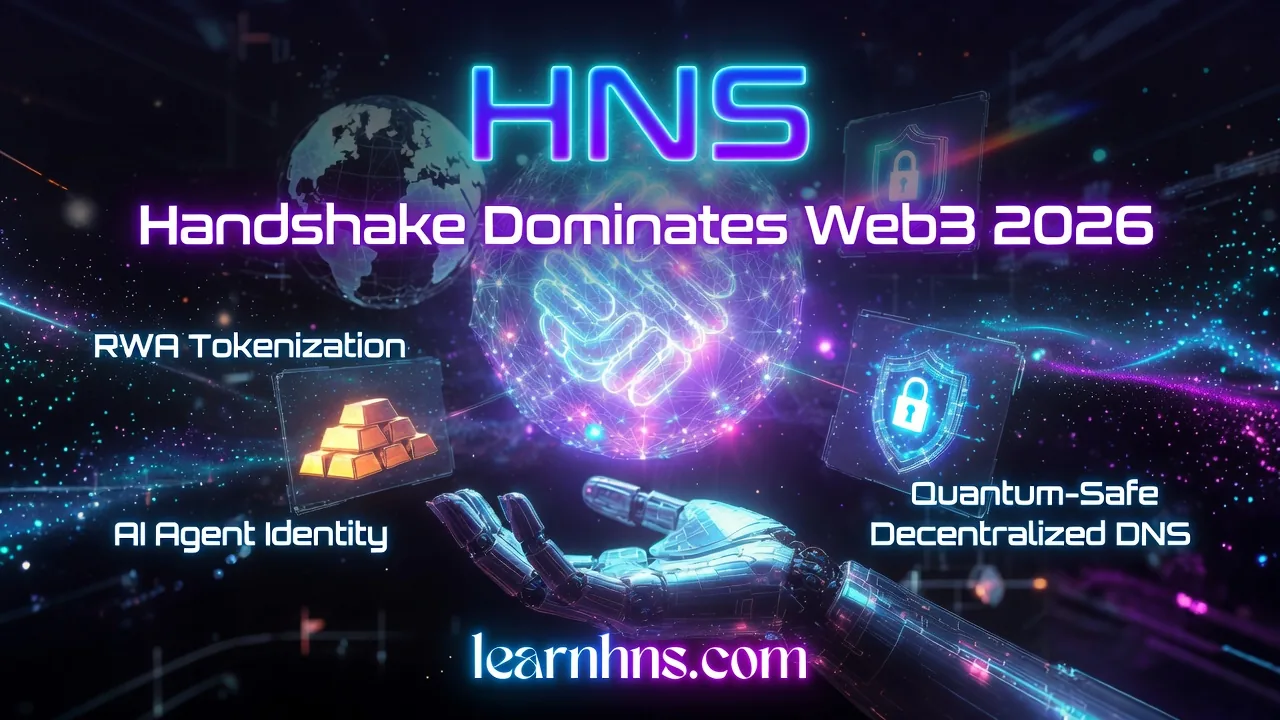
Web3 is moving fast. Handshake was already there.
Every few months, a new trend takes over the crypto and Web3 conversation. Right now, four topics are dominating search engines, investor decks, and developer forums:
- Real World Assets (RWA) tokenization
- AI agent identity and authentication
- Quantum-safe blockchain infrastructure
- Decentralized DNS vs. ICANN
Here's what most people don't realize: Handshake (HNS) is not chasing these trends. It was built for them. Let's break down each one.
1. Real World Assets (RWA) — The $16 Trillion Opportunity
RWA tokenization is the process of putting real-world value — property, bonds, commodities, art — onto a blockchain as a tradeable token. In 2026, it's one of the fastest-growing sectors in crypto, with institutions like BlackRock, JPMorgan, and Goldman Sachs all actively building in this space.
The fundamental problem with RWA is identity. When you tokenize a property or a financial instrument, you need a permanent, verifiable address for that asset to live at. Traditional DNS can be seized, expired, or redirected. A URL you point your asset at today can disappear tomorrow.
Handshake solves this at the root. A Handshake TLD is cryptographically owned — no registrar can take it, no government can seize it, and it never expires as long as the owner renews it on-chain. That makes it the ideal namespace layer for RWA protocols.
Think of it this way: if you're tokenizing a building in Dubai as an NFT, that NFT needs a permanent home. A Handshake SLD like dubai-tower.realestate/ on a sovereign TLD is provably yours forever. No central authority can pull it out from under you.
Projects building real estate NFTs, title deed registries, and fractional ownership platforms should be building on Handshake TLDs — not ICANN domains that can be suspended, transferred, or lost.
2. AI Agent Identity — The Problem Nobody Is Talking About Yet
AI agents are autonomous software programs that browse the web, execute transactions, and interact with APIs on behalf of humans. In 2026, they are everywhere — from trading bots to customer service systems to on-chain DeFi managers.
Here's the critical issue: how do you verify the identity of an AI agent?
If an AI agent calls your API, signs a transaction, or communicates on your behalf, you need to know it is authentically yours and hasn't been compromised or spoofed. Traditional domain-based authentication (TLS certificates from ICANN domains) is vulnerable to hijacking, rogue certificate authorities, and man-in-the-middle attacks.
Handshake provides a better identity layer for AI agents. Each agent can be assigned its own subdomain (SLD) under a Handshake TLD you control. The identity is backed by cryptographic proof on the Handshake blockchain — not by a certificate authority that can be hacked or coerced.
Combined with DANE (DNS-Based Authentication of Named Entities) and DNSSEC anchored to the Handshake root zone, AI agent identity on HNS becomes tamper-proof by design. No third party can issue a fake certificate for your agent's domain.
As AI agents become more financially capable — signing transactions, managing wallets, executing contracts — having their identity rooted in a decentralized, cryptographic namespace will stop being a nice-to-have and become a security requirement.
3. Quantum-Safe Infrastructure — The Clock Is Ticking
Quantum computers are getting faster. NIST finalized its first post-quantum cryptography standards in 2024. Governments and financial institutions are now actively migrating away from classical cryptographic algorithms like ECDSA and RSA, which quantum computers can break using Shor's algorithm.
Bitcoin and most blockchain networks are not yet quantum-safe. Their transaction signing relies on elliptic curve cryptography (ECDSA secp256k1), which a sufficiently powerful quantum computer could crack — exposing private keys from public keys.
Handshake's architecture is designed with this future in mind. The Handshake protocol supports post-quantum cryptographic algorithms including FALCON, CRYSTALS-Dilithium, and SPHINCS+ — all NIST-approved PQC standards. This means Handshake TLD ownership can be secured with quantum-resistant keys today, before the threat becomes a practical reality.
For infrastructure that needs to last decades — domain registries, title deed systems, identity records, banking security layers — choosing a quantum-safe foundation now is not paranoia. It's engineering discipline.
Handshake is one of the very few blockchain naming systems that takes post-quantum readiness seriously at the protocol level.
4. Decentralized DNS vs. ICANN — A Fight That's Heating Up
ICANN has controlled the internet's root zone for decades. It decides which TLDs exist, who can register them, how much they cost, and under what conditions they can be suspended. In 2022, ICANN suspended Russia's internet domains under political pressure. In 2024, it seized several crypto-related domains at the request of law enforcement.
The Web3 community has been watching. The question — can a single centralized organization control the entire internet's naming system? — is now mainstream.
Handshake is the most mature, production-ready answer to this question. It replaces the ICANN root zone with a blockchain-based alternative where:
- TLD ownership is determined by cryptographic proof, not ICANN approval
- No single entity controls what TLDs exist
- Domains cannot be seized by registrars or governments
- Resolution is peer-to-peer, not dependent on centralized servers
Unlike ENS (which operates as a subdomain of Ethereum's ecosystem) or Unstoppable Domains (which relies on centralized resolution layers), Handshake operates at the actual DNS root level. It's not a workaround — it's a replacement.
As more developers, privacy advocates, and institutions ask "what happens when ICANN makes a decision I disagree with?", Handshake becomes the answer they find.
Why This Matters for You Right Now
These four trends — RWA, AI identity, quantum safety, and DNS decentralization — are not niche topics. They are the next phase of the internet's infrastructure debate. Billions of dollars are flowing into each of them.
Handshake is uniquely positioned at the intersection of all four. It is the only blockchain naming protocol that:
- Provides sovereign, permanent namespaces for RWA assets
- Offers cryptographic identity for AI agents without certificate authorities
- Supports post-quantum cryptographic standards at the protocol level
- Operates as a true ICANN alternative at the DNS root zone
The question isn't whether these trends will reshape the internet. They already are. The question is whether the infrastructure being built to support them will be centralized and fragile — or decentralized and sovereign.
Handshake already made its choice. Now the rest of the world is catching up.