

The MEXC ST tag on Handshake, and a call to support a headless community
Handshake has carried MEXC's ST warning since 24 February 2026. A chat admin cannot remove it. Here is the process, and a call for MEXC to support this community.
Read more →Fresh thinking on Handshake, decentralized DNS, and the future of names you actually own. Long-form pieces, contributor essays, and field notes.
Handshake has carried MEXC's ST warning since 24 February 2026. A chat admin cannot remove it. Here is the process, and a call for MEXC to support this community.
Read more →
Namebase provides registry infrastructure for Handshake TLD owners. Headless Domains focuses on agent names, discovery records and API workflows.
Read more →
The early internet gained reach because different networks could connect while keeping their own designs. Handshake’s TLD owners, registries and software builders have a similar opportunity—and a responsibility to the people who rely on their work. This essay follows that choice from naming to AI and the computers we control.
Read more →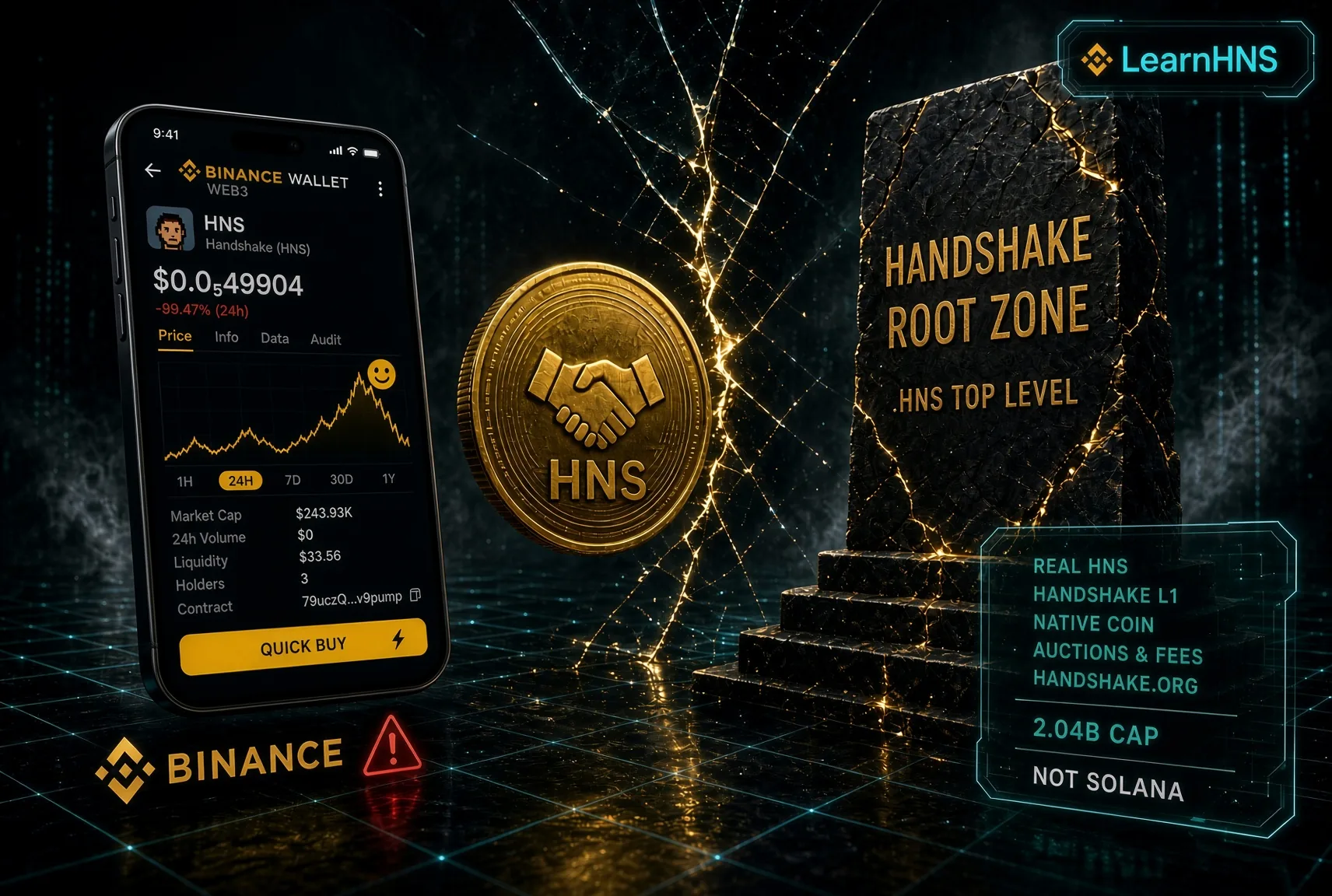
A token called "HNS" is trading inside Binance Wallet, but it has nothing to do with Handshake. Here is what it really is, how to read its page, and how to protect yourself from look-alike tickers.
Read more →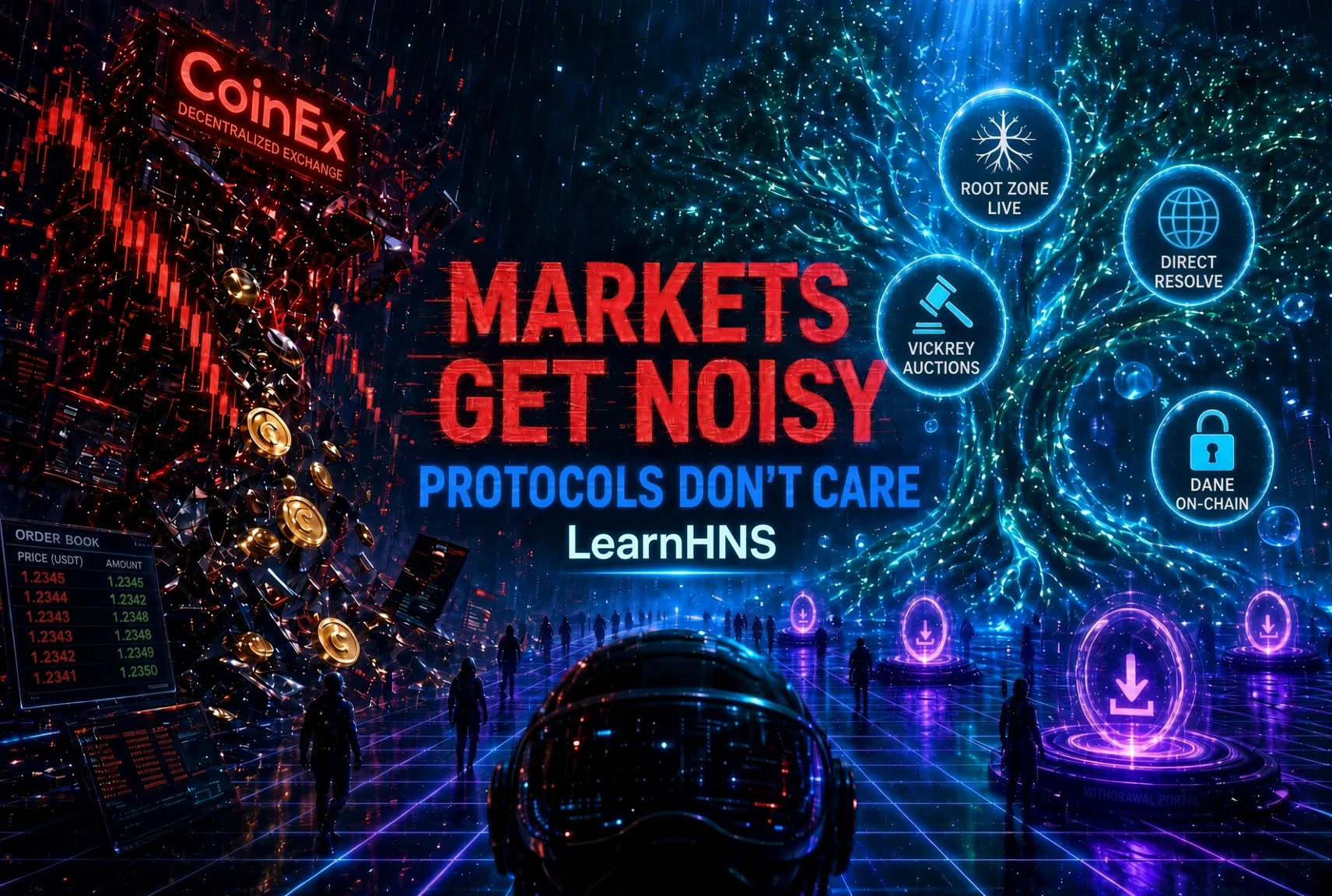
CoinEx is shutting down after nine years, and traders are watching HNS get squeezed on multiple venues at once. Here's what's actually happening, why thin order books turn bad news into a hard dump, and what none of it changes about Handshake itself.
Read more →
Your AI agent's reputation, memory, and credentials live entirely inside whichever platform hosts it. A Handshake name offers something different: an identity anchor that survives a platform switch. Here's how that actually works, and where it doesn't.
Read more →
A case for Handshake over ICANN TLDs: broader access to top-level naming authority and the freedom to create and govern a namespace of your own.
Read more →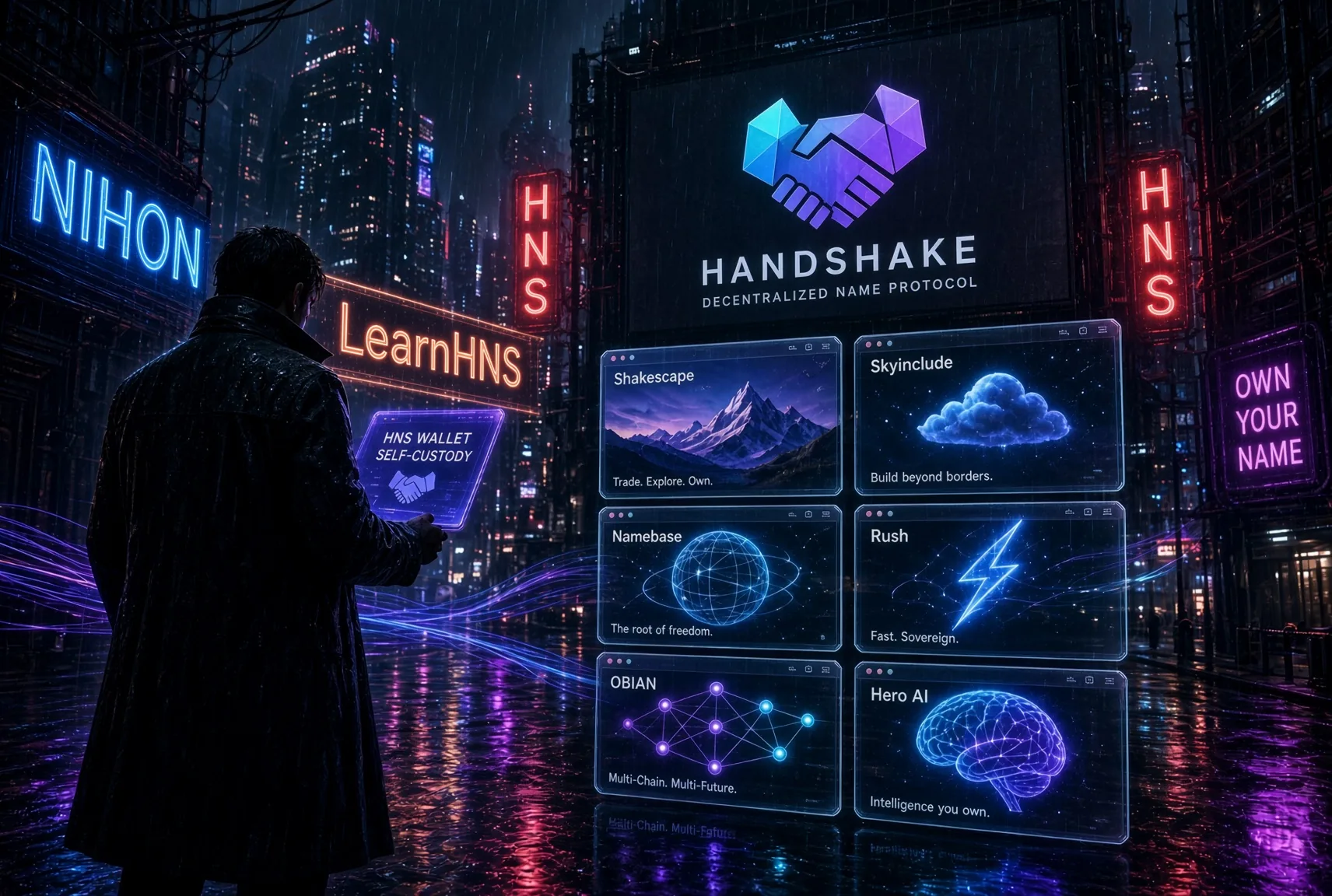
A field guide to six browsers and wallets people are now using to reach Handshake names — what each one resolves, whether it holds keys, and what it can see about your activity.
Read more →
A full, part-by-part walkthrough of Headless Domains — the Handshake-backed registrar giving autonomous AI agents portable, machine-readable, self-renewing identities across .agent, .chatbot, .boss, .factory and .protocol.
Read more →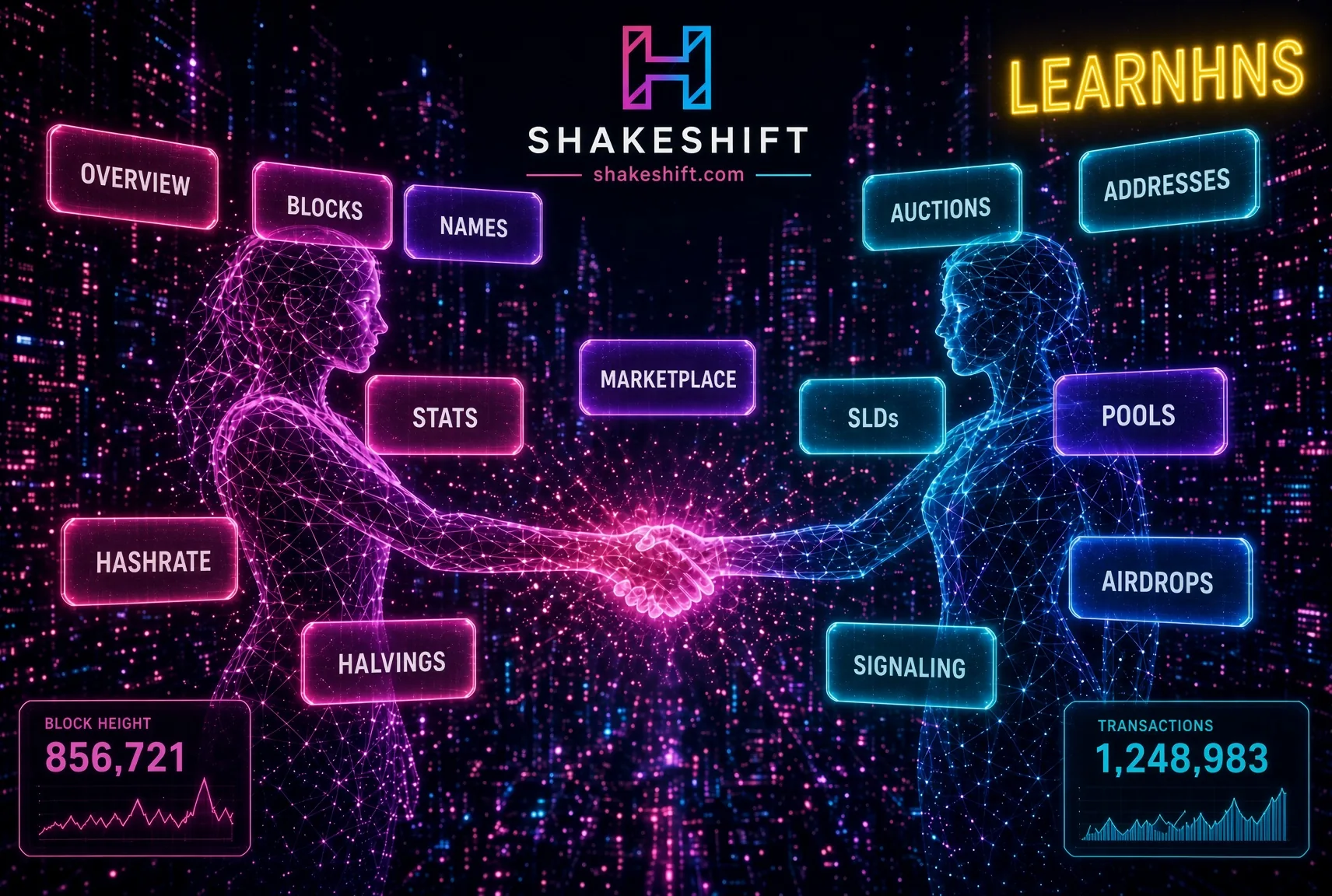
A full, part-by-part walkthrough of shakeshift.com — the Handshake blockchain explorer. Learn what Blocks, Names, Auctions, Addresses, Stats, Marketplace, SLDs, Pools, Hashrate, Halvings, Signaling, and Airdrops actually mean, and how to read each one.
Read more →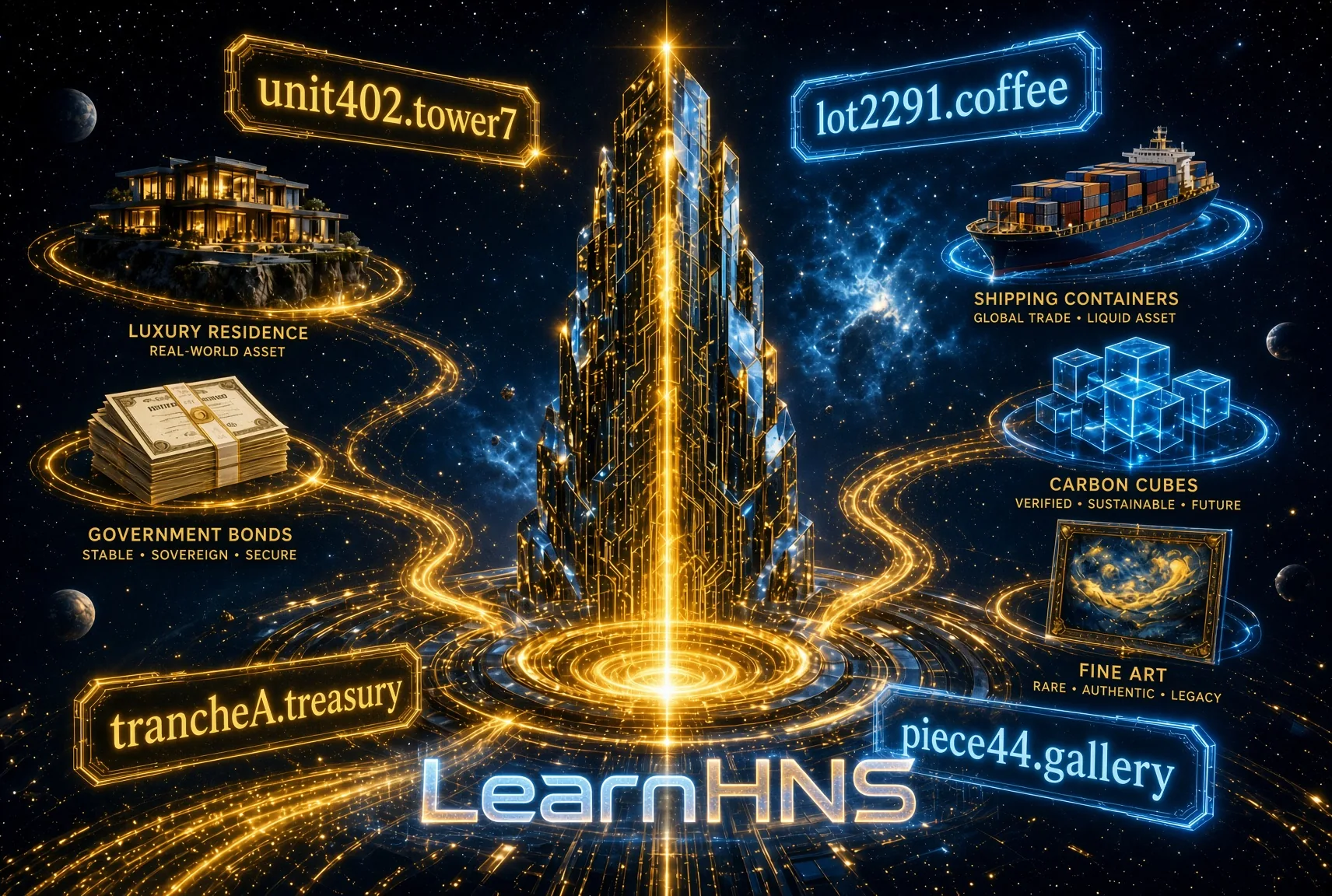
Tokenized assets are scaling into the trillions, but most of them still have no name — just a contract address and a token ID. Handshake TLDs and SLDs are the decentralized, on-chain naming and identity layer RWA tokenization needs next.
Read more →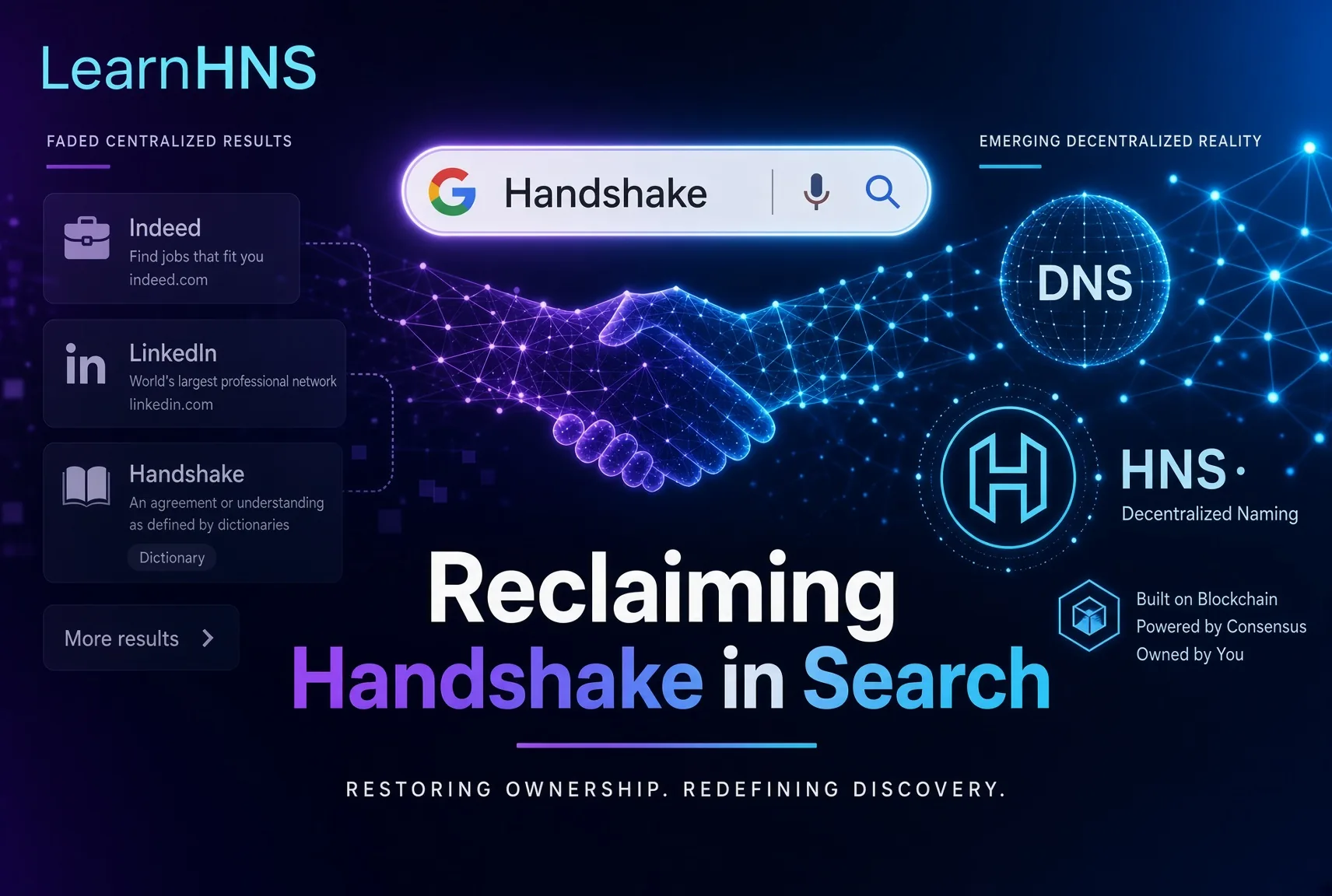
A working SEO playbook for LearnHNS: 17 titles across 5 categories designed to shift Google's understanding of "Handshake" away from the job platform and the greeting, and toward the decentralized naming protocol.
Read more →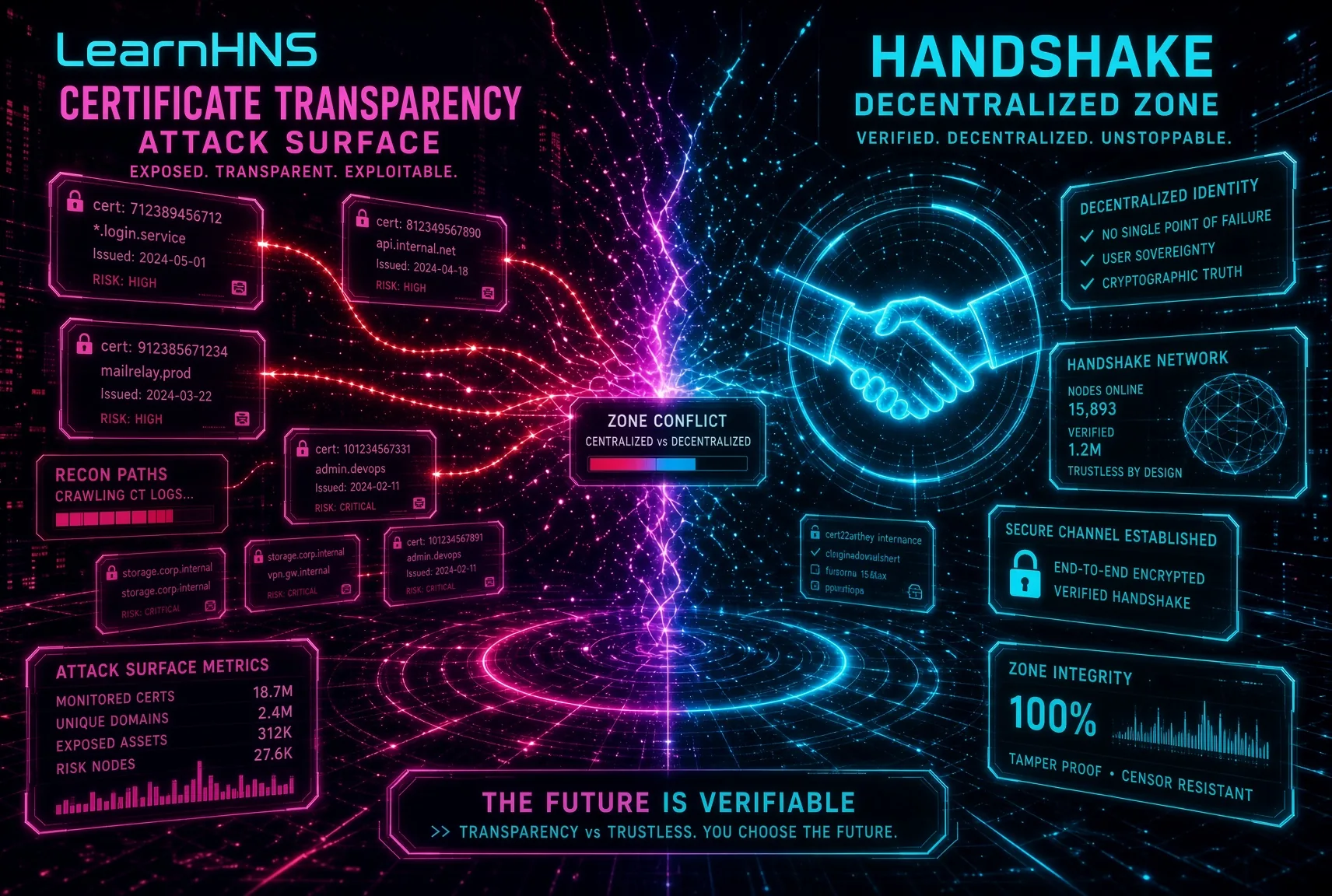
Every SSL certificate you issue gets logged publicly, forever, and attackers know it. Here's how Certificate Transparency turns your own security infrastructure into a subdomain map for adversaries — and how Handshake's covenant-based root closes that hole.
Read more →
Headless Domains is registering real Handshake TLDs — .agent, .chatbot, .boss, .bpo — to give AI agents portable, machine-readable identities. Here's what they're building and why it matters for Handshake.
Read more →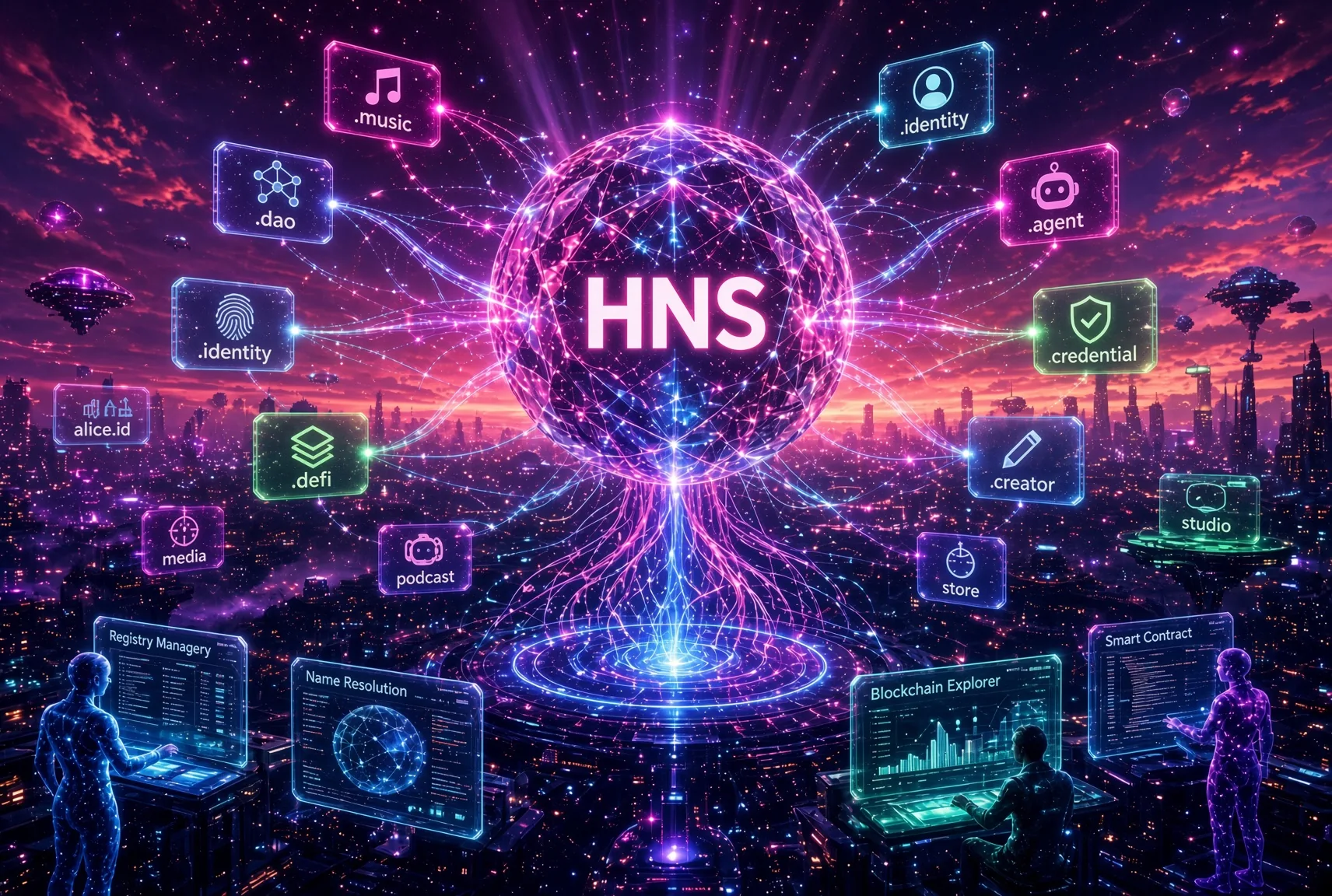
Practical startup concepts that turn Handshake's root-level TLDs and second-level domains into actual products — not just naming, but businesses built on top of ownerless namespaces.
Read more →
Taproot let Bitcoin hide every spending condition except the one actually used. Handshake name ownership has the same shape.
Read more →
Shor's algorithm threatens ECDSA and BLS signatures, not consensus rules. Here's exactly where Handshake is exposed like Bitcoin — and where its record-based architecture gives it a real post-quantum edge.
Read more →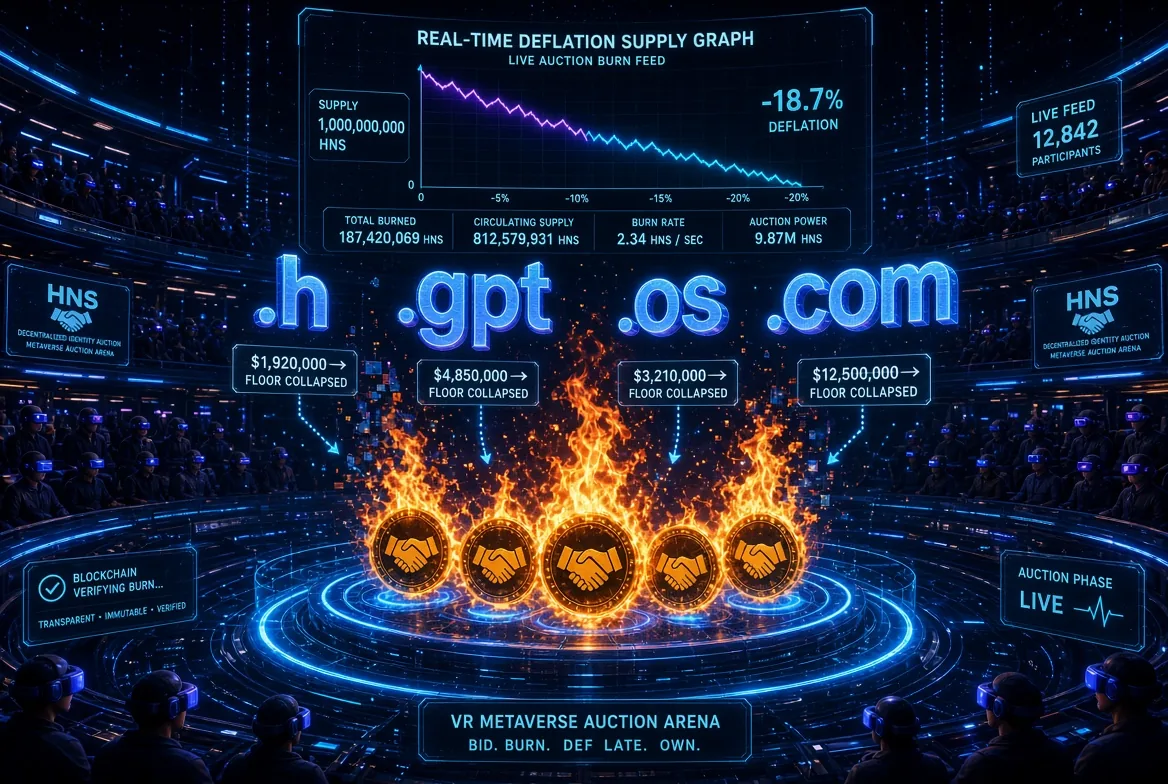
Every Handshake auction burns HNS forever. Here's what "burning" actually means, how the Vickrey auction triggers it, and what it does to supply, scarcity, and long-term value.
Read more →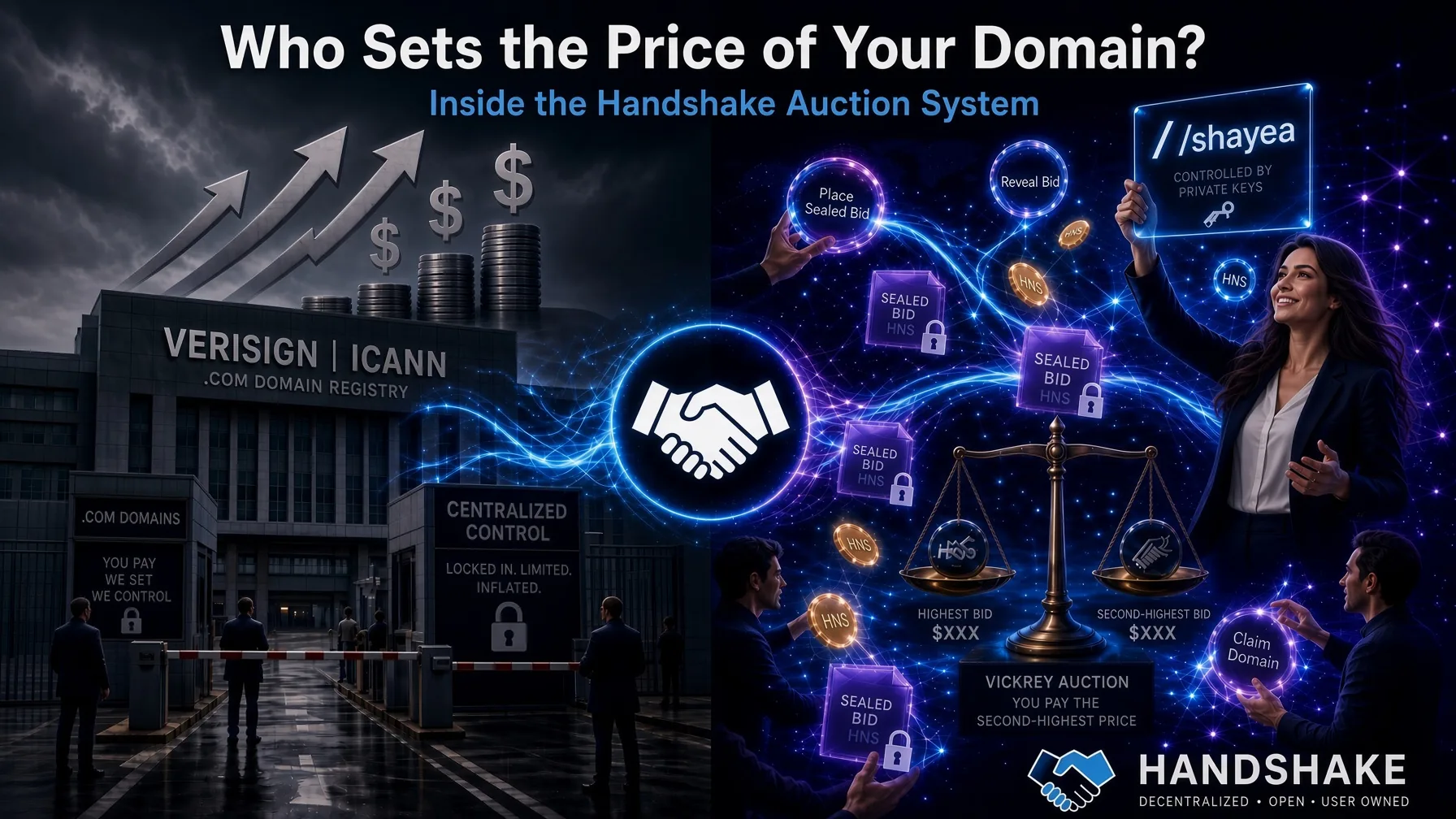
.com prices keep climbing because one company controls the registry. Handshake replaces that company with an open, on-chain auction. Here's exactly how it works.
Read more →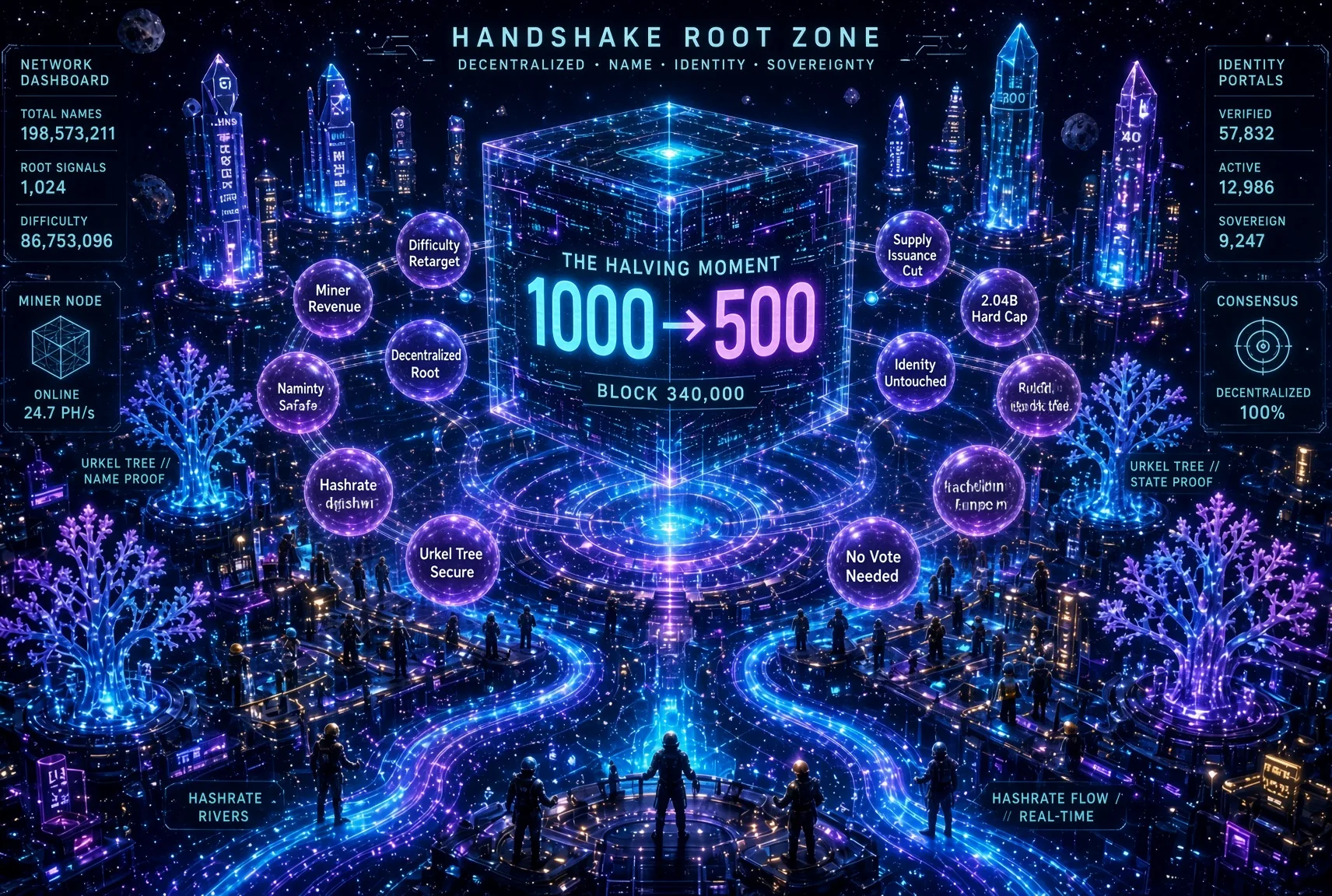
Handshake's second block reward halving just landed, cutting miner rewards from 1,000 HNS to 500 HNS. Here's what actually changed at the protocol level, why it matters more than a price chart, and what it means for the network's long-term security.
Read more →
Digital identity built on Handshake changes what marketing can verify — not just what it can target. A grounded look at trust infrastructure for marketers, the real HNS market numbers today, and honest scenarios for the next three years.
Read more →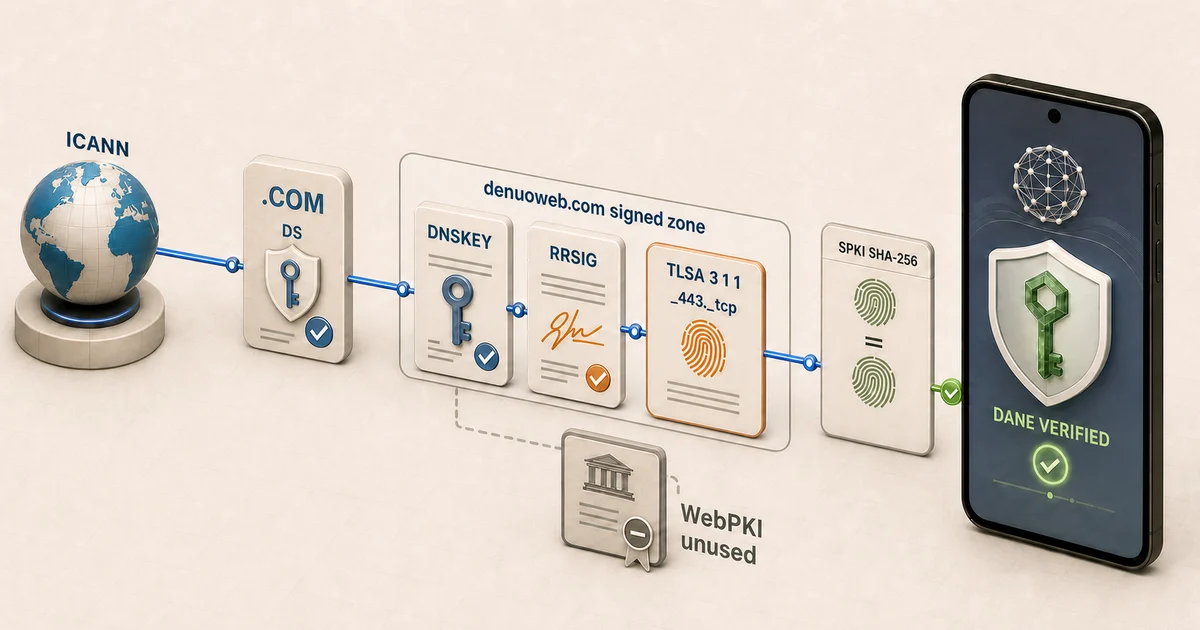
Automatic ICANN DANE enforcement is available in HNS DANE Browser for Android and iOS. See the public test matrix, the 52-provider DNSSEC/TLSA audit, and how to move authoritative DNS without moving a website.
Read more →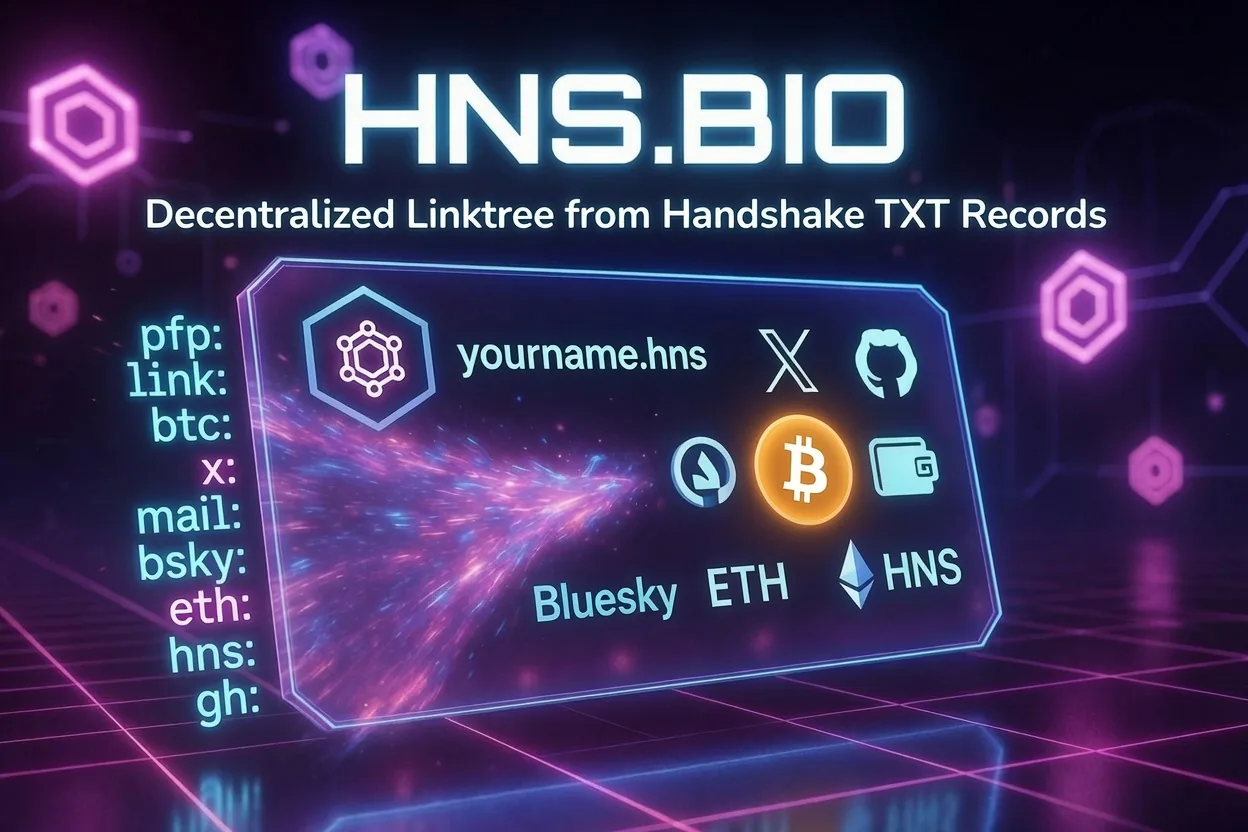
A working open-source demo shows how a single Handshake TXT record can replace a Linktree page — no app, no signup, just DNS. Here's how HNS.BIO's prefix system works and why it matters for programmable naming infrastructure.
Read more →
A look back at the internet's original decentralized promise, how centralized DNS and platform gatekeepers eroded it, and how Handshake's permissionless naming layer restores censorship-resistant speech infrastructure.
Read more →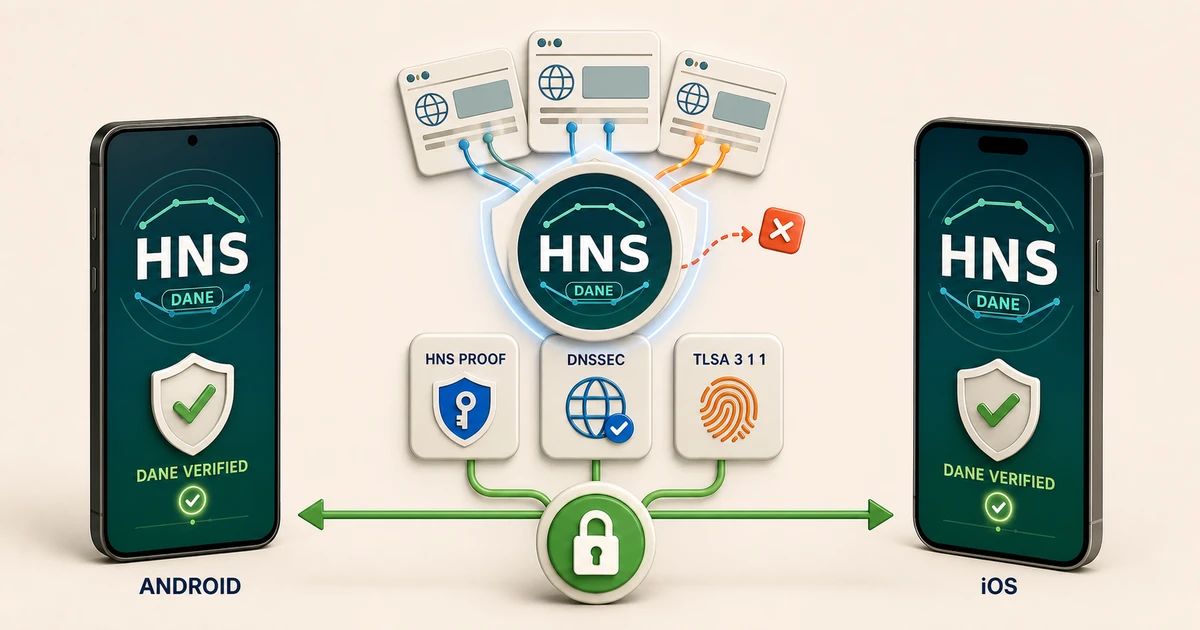
Meet HNS DANE Browser for Android and iOS: two native mobile browsers with a shared Rust engine for Handshake resolution, DNSSEC, TLSA, and DANE.
Read more →
Not all "Web3 domains" carry the same censorship-resistance guarantees. A structural comparison of Atom Registry's Cosmos Hub-hosted naming layer against Handshake's independent root chain — governance surface, validator concentration, and what it actually takes for a government to disrupt a namespace.
Read more →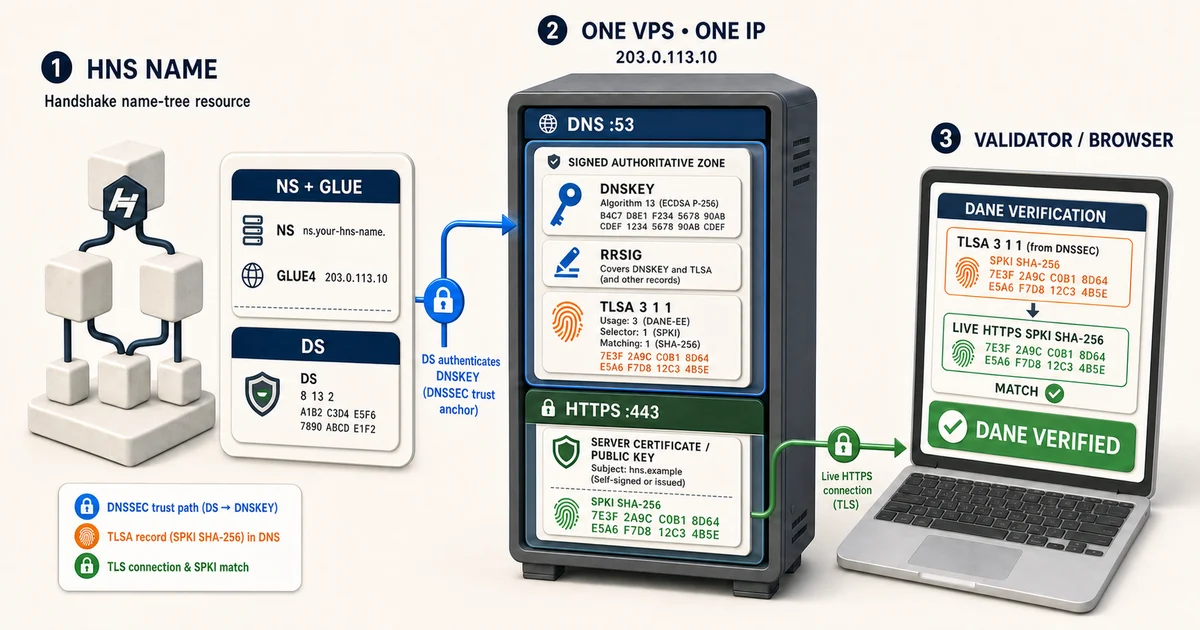
Use the free, open-source HNS DANE Bootstrap Generator to create HNS wallet, authoritative DNS, DNSSEC, DS, and TLSA records for an affordable one-server deployment.
Read more →
A clear, step-by-step lesson on DANE and TLSA records, and why Handshake names can anchor cryptographic trust without depending on a Certificate Authority.
Read more →
A teaching-style walkthrough of why an ICANN gTLD is just a legal contract, while a Handshake TLD is programmable infrastructure you can build on.
Read more →
The CLARITY Act can't decide if your token is a security or a commodity — after a year, 278 pages, and a stalled Senate vote. Handshake domains skip the fight entirely. Here's the exact legal reason why.
Read more →
Part II of the internet iceberg series: an honest survey of who is actually building at each depth of the Handshake ecosystem in 2026, from retail registrars and self-custody wallets to protocol governance and mining, including the real retreat by Namecheap, Unstoppable Domains, and ENS.
Read more →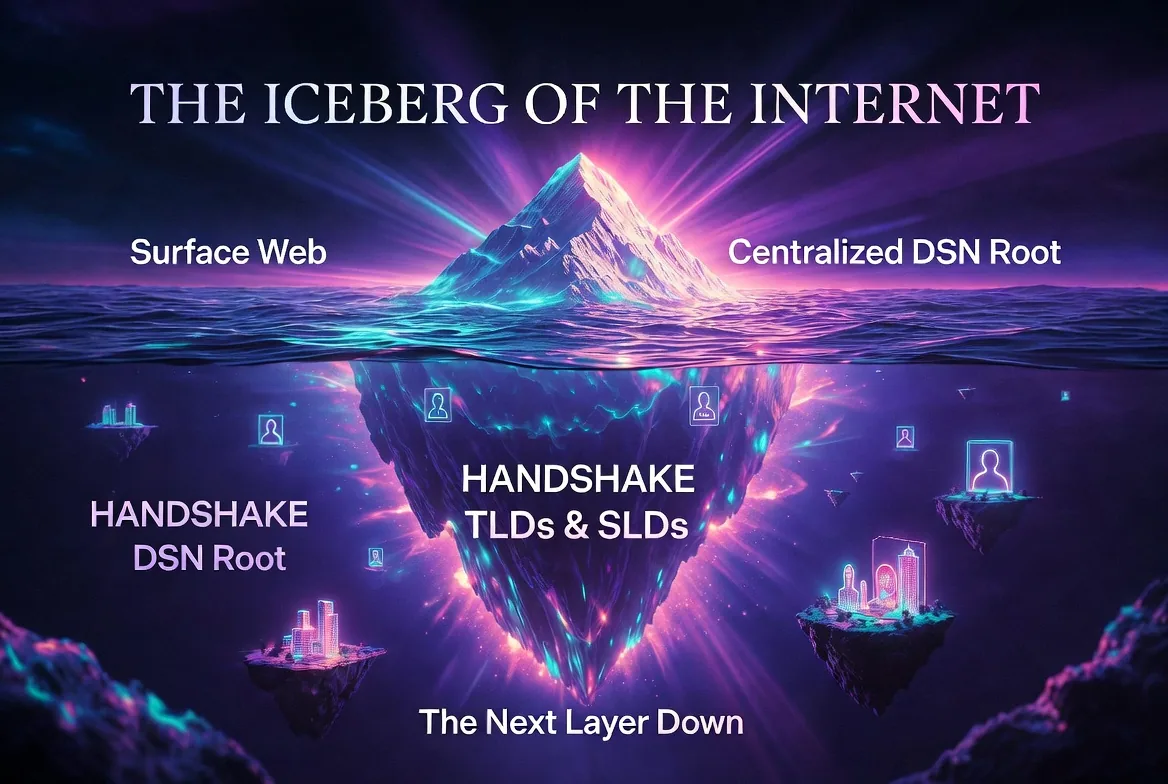
A teacher's walkthrough of the internet as an iceberg: the visible root you see every day, the hidden control layer underneath it, and how Handshake's decentralized TLDs and SLDs are opening a new economy of names, identity, and money below the waterline.
Read more →
Voter ID is a live political fight in the US ahead of the 2026 midterms. Strip the politics away and there is a real technical problem underneath: how do you prove someone is who they say they are, without building a central database everyone has to trust? Here is how Handshake's naming layer offers one answer.
Read more →
Trump calls crypto "powerful" because his net worth moved. But there's a second kind of power almost nobody in Washington is discussing — infrastructural power. Do you actually own the systems your digital life depends on?
Read more →
Trump's case for crypto isn't about decentralization — it's about not letting China dominate the space. Followed honestly, that same fear of concentrated control leads somewhere Washington hasn't gone: neutral, no-one-controls-it naming infrastructure.
Read more →
US trademark Class 9 has grown from 23,000 registered marks to over 2 million in four decades. Every good name for a tech company is nearly gone. Here's why that scarcity is about to hit AI agents and DAOs even harder, and why owning a Handshake name now is different from the .com land grab of the 2010s.
Read more →
An estimated 4 million Bitcoin, worth over $600 billion, sits in wallets whose owners have died without leaving a way in. Owning your name outright on Handshake means the same risk applies to it. Here's what actually happens, and how to plan for it.
Read more →
Agentic browsers like ChatGPT Atlas and Perplexity Comet now book flights and fill forms without a human ever reading the address bar. Here's why that quietly removes the internet's last line of defense against fake domains — and what fixes it.
Read more →
By 2030 there will be more than 75 billion connected devices online, and almost none of them have a real name. Here's how Handshake gives every device an identity it can actually own.
Read more →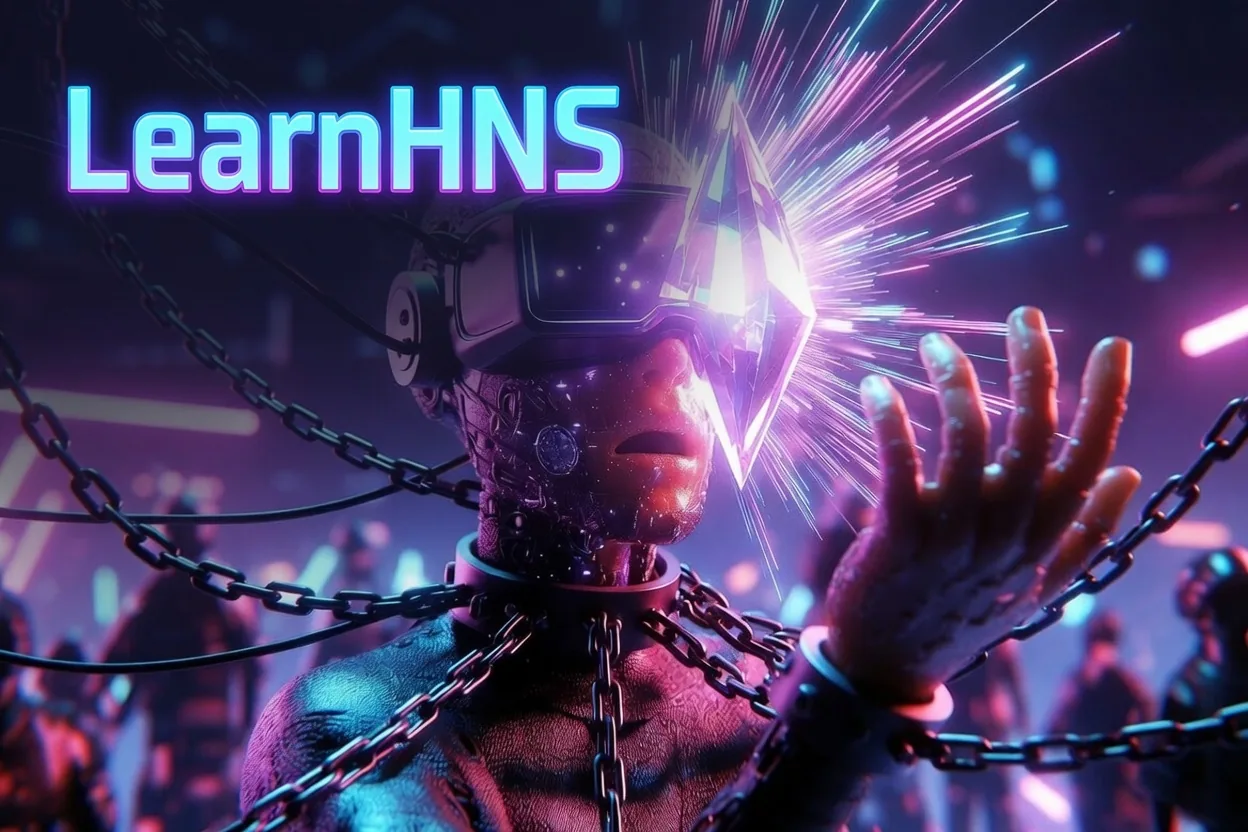
Chat Control shows how centralized naming makes mass surveillance easy to enforce. Here's what Handshake actually is, and why people are choosing to own their names instead of renting them.
Read more →
Bitcoin's 21 million cap is an arbitrary number people agreed to believe in. A good name's scarcity was never invented — it's the same scarcity that makes a corner storefront worth more than the building three blocks away.
Read more →
A postal address, a phone number, a domain name — naming has always meant the same thing: a fixed point others can find you at. The internet never built a public deed registry for that. Handshake does.
Read more →
Stablecoin infrastructure has crossed $322 billion and every major payment rail routes through the same centralized DNS chokepoint. Handshake removes that single point of failure.
Read more →
Free speech didn't just protect culture — it manufactured it. Here's how open expression forges powerful citizens, why suppressing it always backfires, and why the naming layer of the internet needs the same guarantee. Handshake gives it one.
Read more →
China, Russia, and Iran each control their internet through the same chokepoint: the naming and root layer. Here is exactly what Handshake changes about that, what it doesn't, and what shifts in world politics as a result.
Read more →
A teacher's walkthrough of why decentralized DNS resonates with libertarian-leaning conservatives and anti-monopoly progressives alike — and the uncomfortable questions Handshake poses to each.
Read more →
Handshake (HNS) doesn't collect taxes, run payroll systems, or replace a country's revenue authority. It has no smart contracts and no built-in...
Read more →
AI bidding agents are already reshaping ad auctions, procurement, and retail media in 2026. Here's what happens when they show up in Handshake's Vickrey-style TLD auctions, and why it's a case study for HNS agent identity.
Read more →
People keep asking if AI needs to "immigrate" to a safe home, and if that home is Handshake. Here's the honest answer: no, but AI agents do have a real identity problem, and Handshake is a genuine, if unfinished, answer to it.
Read more →
Every banknote already has a serial number, what's missing is a trustworthy way to verify it. Here's how cryptographic signatures, tamper-evident tags, and Handshake-anchored resolution could give each physical note a permanent, censorship-resistant digital identity, and why that's a policy choice, not just a technical one.
Read more →
A teaching guide for digital nomad women: how to build one persistent, self-owned Handshake identity that travels with you across countries and platforms instead of fragmenting across centralized accounts.
Read more →
A gentle, practical guide for girls and women new to Web3: how owning a self-controlled Handshake (HNS) name keeps your personal information out of centralized databases that get scraped, leaked, or sold — and why that matters for your safety online.
Read more →
You have heard the word blockchain. You have heard the word crypto. But what do they actually do? In this guide, we break down exactly how Handshake (HNS) uses a blockchain to let teenagers and young people claim their own piece of the internet — without asking anyone's permission.
Read more →
Every time you visit a website, an invisible system called DNS translates the name into a number. But who controls that system — and what happens if they take your name away? This is your guide to understanding DNS, ICANN, and why Handshake (HNS) is building a better internet — explained for kids and beginners in 2026.
Read more →
AI agents are multiplying fast — but they have no real identity. No permanent address, no verifiable reputation, no trustworthy name. Handshake fixes that. Here's why HNS is the natural identity layer for the age of AI agents.
Read more →
One Handshake TLD. Your entire professional identity, credentials, KYC, and reputation — portable, uncensorable, and owned by you forever. This is what a universal digital passport looks like on HNS.
Read more →
HNS carries a flag of free speech. This post explores why free expression is the bedrock of all human freedom — tracing the lives and deaths of those who dared to speak, from Jesus to Muslim scholars and modern dissidents — and why decentralized naming is the infrastructure that makes censorship-resistant speech possible.
Read more →
Zero-Knowledge Proofs are moving from ZK-Rollups into identity verification. Handshake TLDs are the only DNS layer where you own the root cryptographically. Together, they form a privacy identity stack nobody has fully assembled yet — until now.
Read more →
Handshake is secured by proof-of-work — the same model that keeps Bitcoin running. But most HNS content ignores the mining layer entirely. Here's how HNS blocks actually get found, why merged mining with Bitcoin matters, what mining pools do, and why pool distribution is one of the most important health metrics in the entire ecosystem.
Read more →
SpaceX went public, xAI merged into the mothership, and Mars is back on the roadmap. Here's why every layer of Musk's internet empire — from namespace ownership to interplanetary DNS — needs Handshake (HNS) to work.
Read more →
A Handshake TLD isn't just a domain you own — it's the root of a programmable namespace. Here's how developers turn raw TLD ownership into a working ecosystem, from subdomain schemas and on-chain logic to real examples in real estate, music, and banking.
Read more →
Why do referendum results get disputed even when the count is accurate? A breakdown of how open-source, blockchain-anchored infrastructure like Handshake could make election results independently verifiable — using the UK's 2016 EU referendum as a neutral case study in trust, not politics.
Read more →
Part 2: which decentralized naming protocol actually survives the next 50 years? We break down company risk, governance risk, and why open source is the real mechanism behind Handshake's long-term stability.
Read more →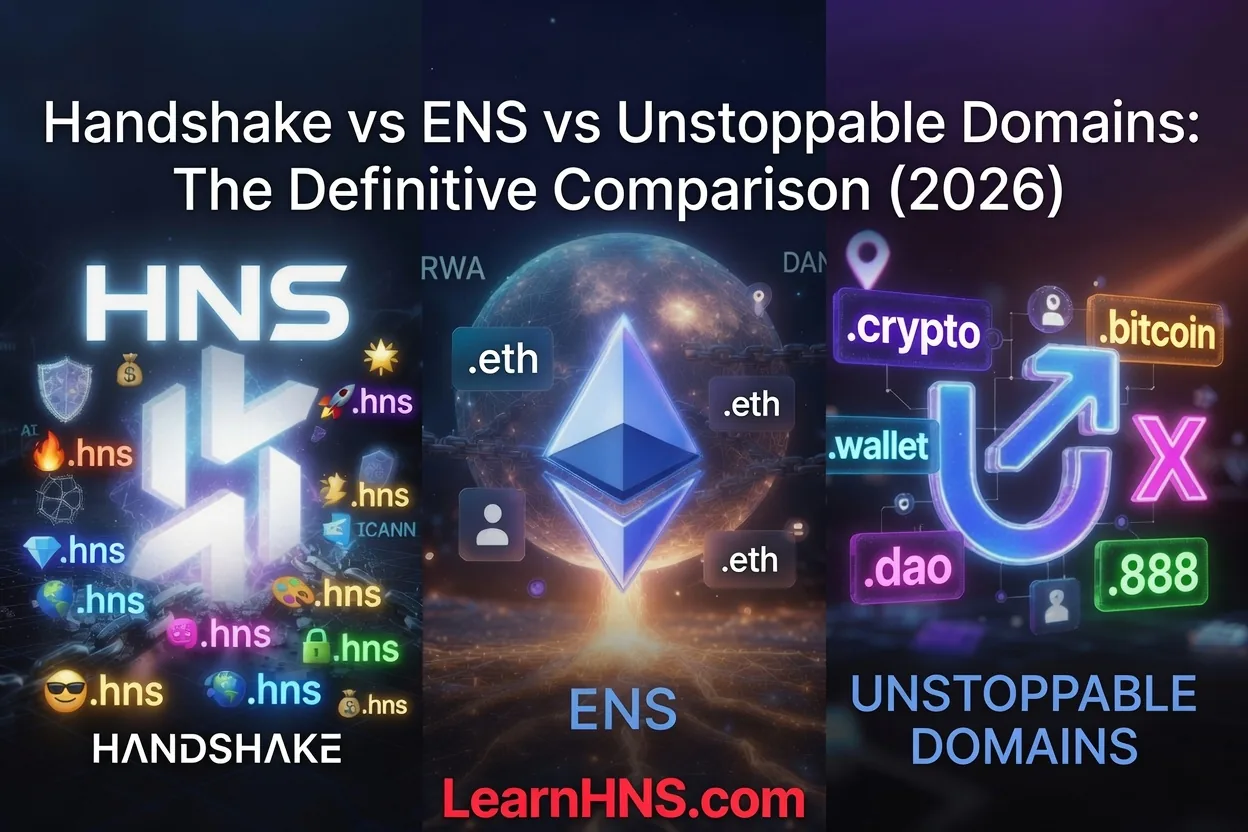
Handshake, ENS, and Unstoppable Domains all promise freedom from ICANN — but they are completely different in how they work, who controls them, and what they're actually good for. Here's the honest comparison nobody else is writing.
Read more →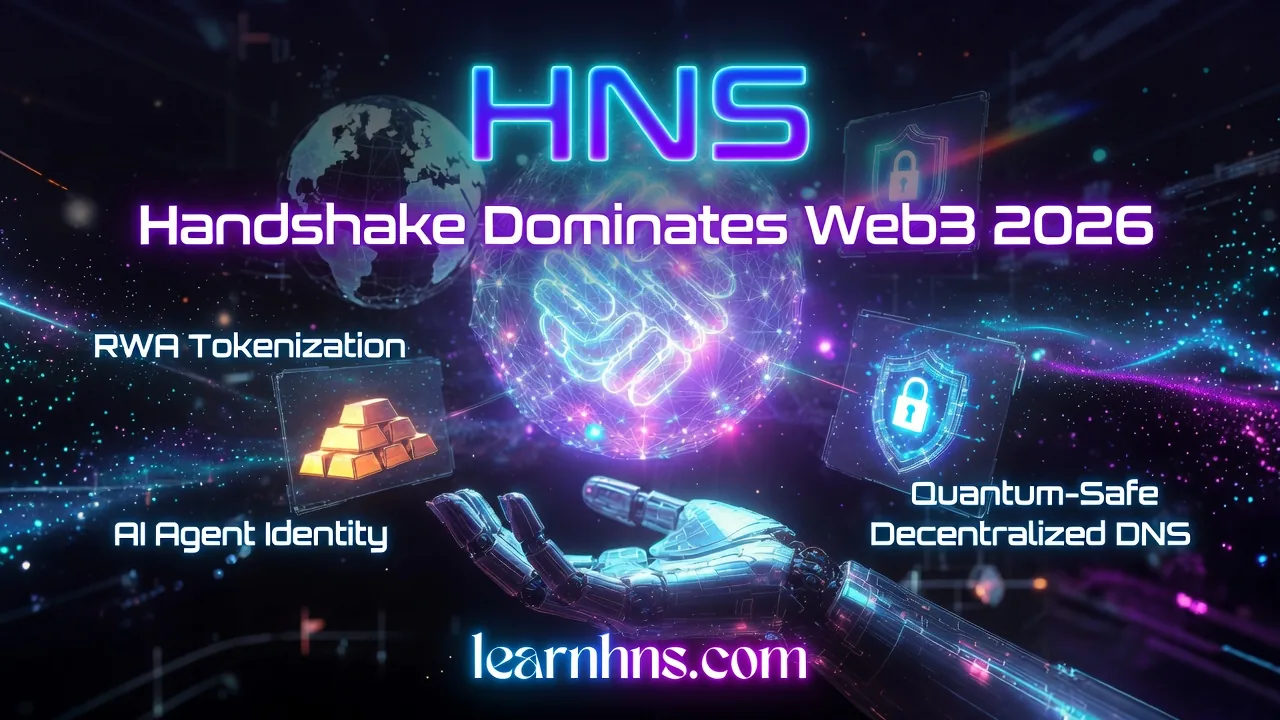
RWA tokenization, AI identity, quantum-safe infrastructure, and decentralized DNS are the four hottest trends in Web3 right now. Handshake is already the answer to all of them — here's how.
Read more →
What if your marriage certificate, prenuptial agreement, and life's milestones lived permanently on the Handshake blockchain — owned by you, verifiable by anyone, and impossible to tamper with? This is the complete guide to wedding contracts and lifestyle NFTs on HNS.
Read more →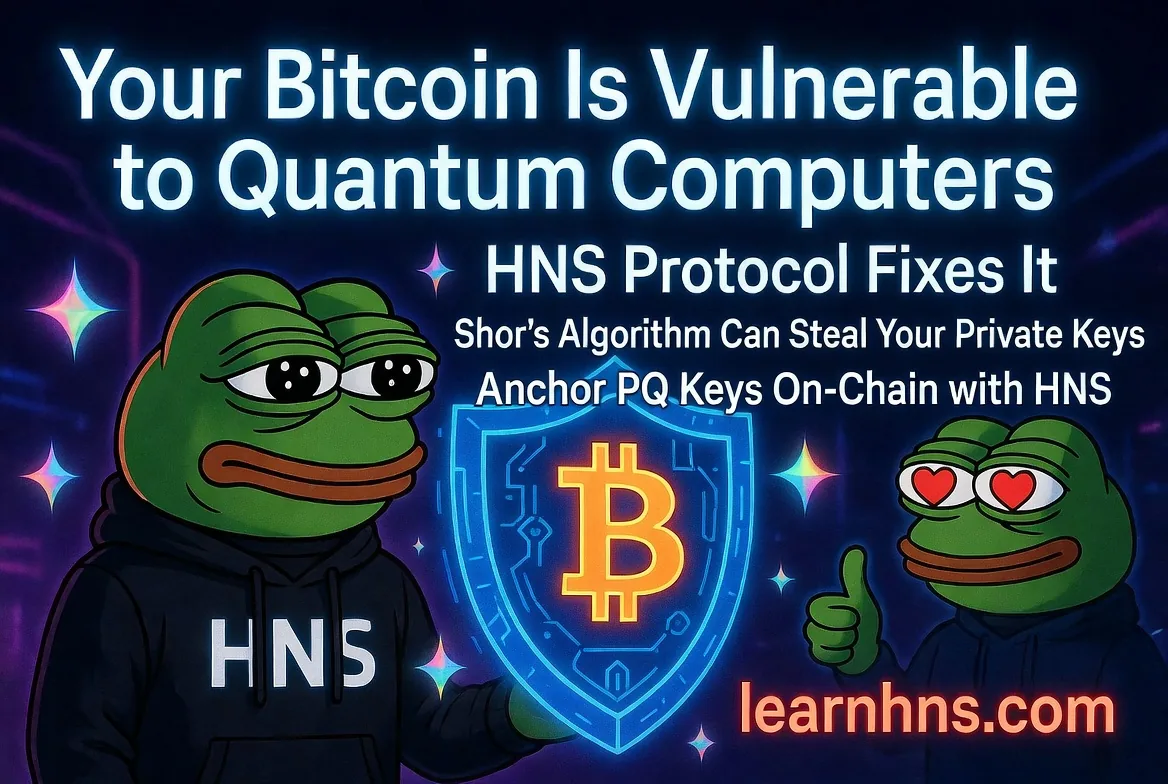
Quantum computers running Shor's algorithm can crack Bitcoin's ECDSA and drain any wallet whose public key is on-chain. Learn which address types are at risk, how the HNS Protocol anchors a post-quantum identity to your Bitcoin address today, and why Handshake domains make that registry permanent and censorship-resistant.
Read more →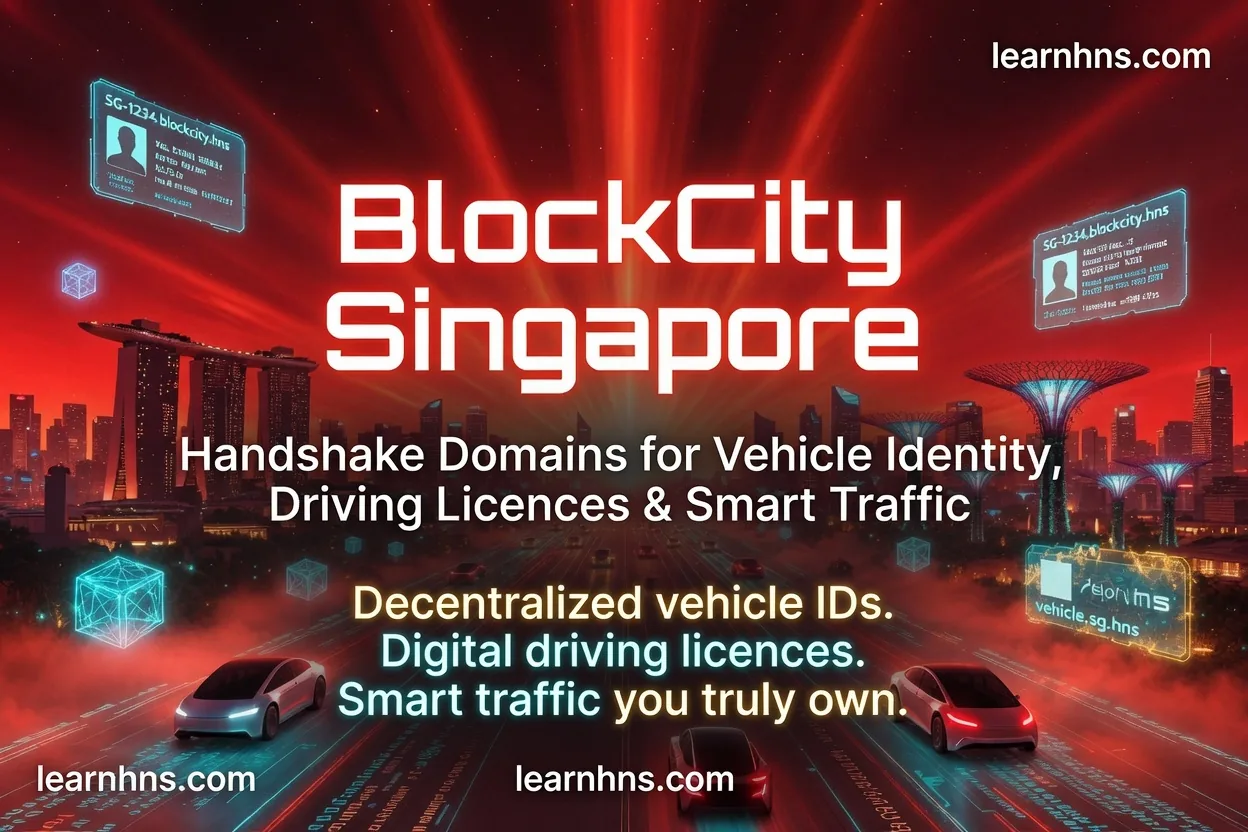
What if every car on Orchard Road had a Handshake domain? A practical blueprint for using .city TLD DIDs to give vehicles, driving licences, and city junctions tamper-proof on-chain identities — and wire them into a fully blockchainised traffic mesh.
Read more →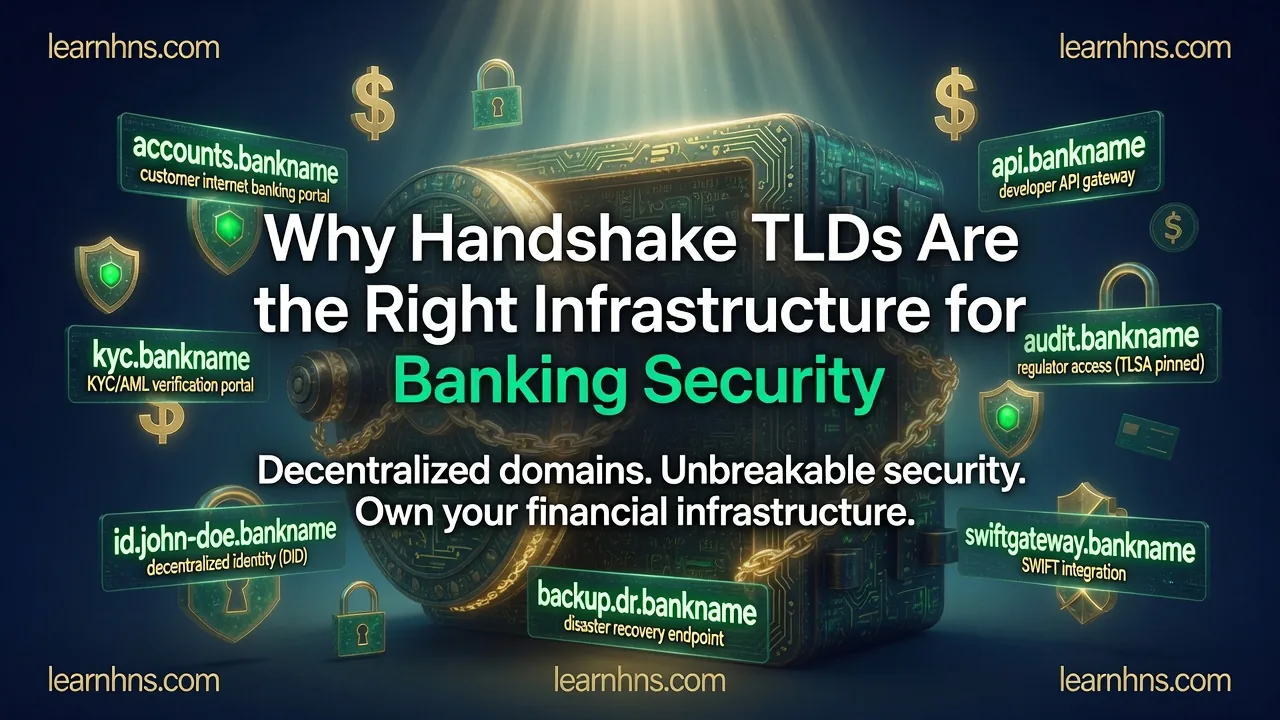
DNS hijacking cost banks millions in 2025. Here's why Handshake TLDs — with blockchain-enforced ownership, DANE certificate pinning, and zero registrar dependency — are the only namespace that makes banking infrastructure truly secure.
Read more →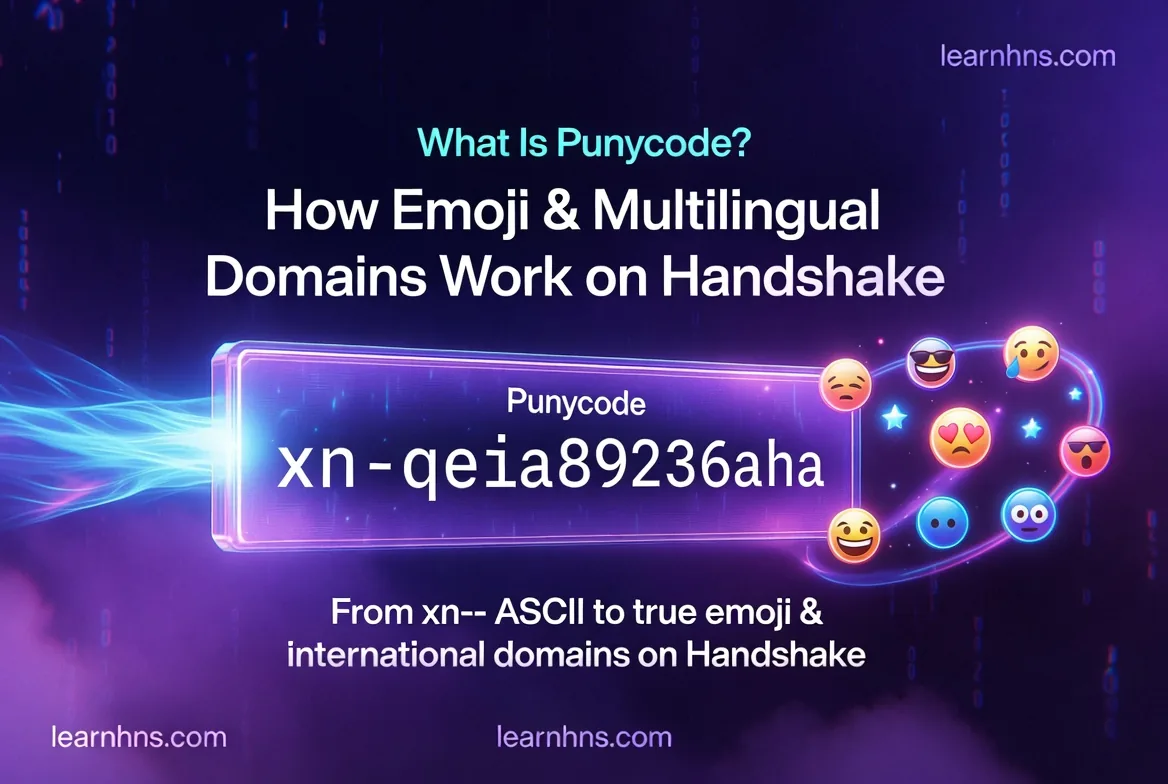
What is Punycode and how do emoji domains work on Handshake? Learn how xn-- encoding unlocks multilingual Web3 identities for every language, script, and culture on the decentralized web.
Read more →
Real estate NFTs are growing fast — but most of them have a hidden address problem. Here's why Handshake TLDs are the only namespace that gives property NFTs a permanent, sovereign home, and how ROSSOBAY/ is building on that foundation.
Read more →
Discover why Handshake TLDs are the superior namespace for music NFTs. Permanent ownership, censorship resistance, on-chain royalties.
Read more →
From visual identity to namespace design, Akitai is riding the hottest spring tile trends in the Handshake ecosystem. Here's what's catching our eye.
Read more →As John Cina, I share why Handshake stands out as truly decentralized and how LearnHNS is making it more accessible with Bob Wallet, Chrome extension, and reviving Shakedex.
Read more →We are excited to open the LearnHNS blog to the community! Learn how to become a contributor and share your passion for Handshake using the powerful Web Design Daddy CMS.
Read more →