

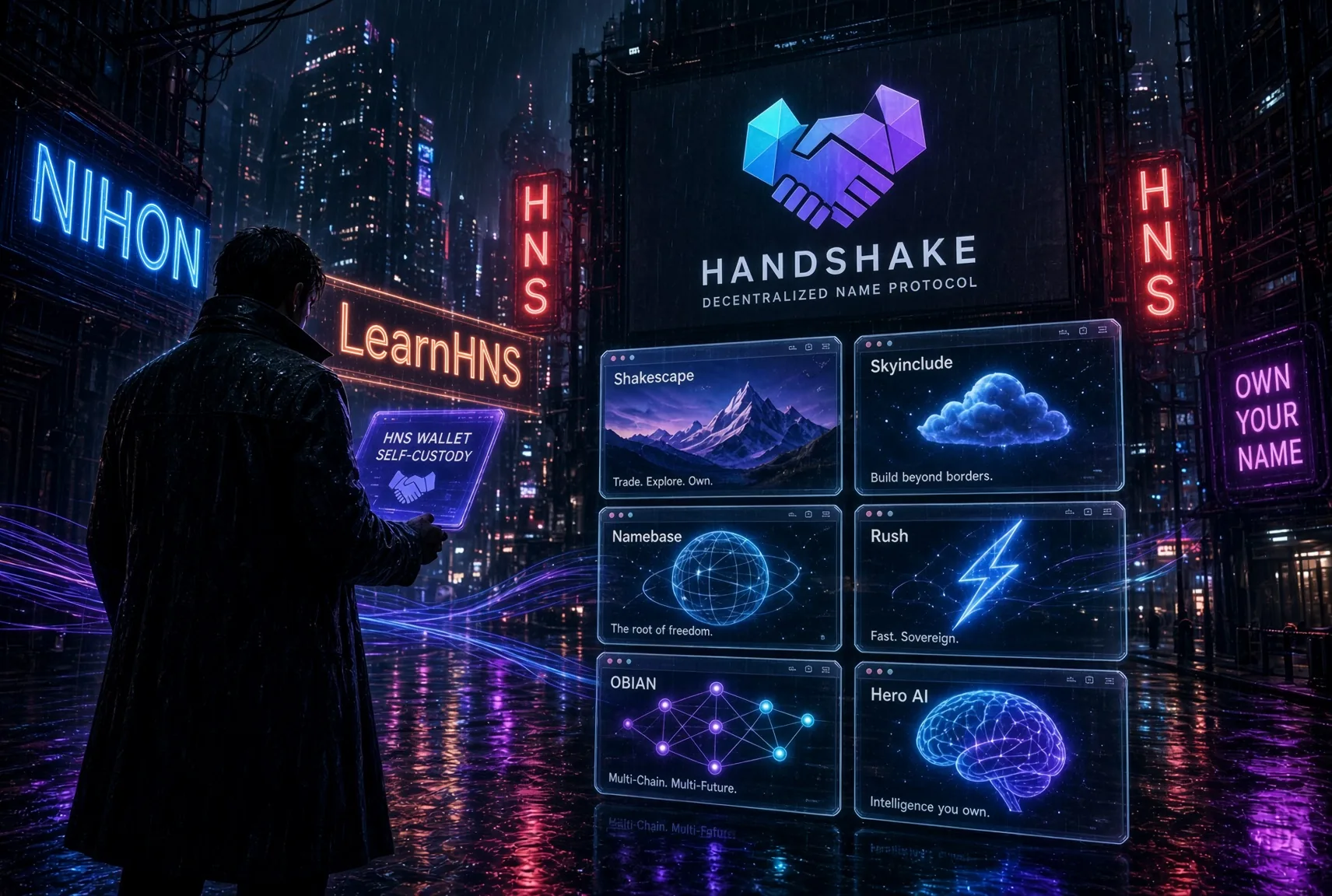
The Handshake access layer keeps growing past the usual short list. Below are six browsers and wallets currently in circulation among HNS users — what each one actually does, how it resolves Handshake names, and what it can (or can't) see about your activity. Treat this as a teaching guide, not a ranking: some of these are mature, some are early builds worth watching rather than trusting with real funds today.
1. Shakescape — dual-root browser with an on-device wallet
Shakescape resolves every hostname through both the Handshake root and the ICANN root, checks the available DNSSEC and DANE evidence for each, and picks a result — failing closed rather than silently trusting a bad answer. Its mobile apps (iOS and Android) bundle a device-local HNS wallet for reads and approved actions; websites cannot request wallet access, and wallet screens stay native rather than exposed to web content.
Activity tracking: Shakescape itself runs no accounts, ads, or analytics, and its code is public under the handshake-rs GitHub organization. That said, the DNS, relay, or recovery service it selects for a given lookup can still see the name you requested and when — the same trade-off every DoH-based resolver carries.
2. OBIAN — a browser for many naming systems at once
OBIAN is a desktop browser aimed at the wider multi-chain naming landscape: it resolves obian/ names on Handshake alongside ENS's .eth, Polygon's .blockchain, Base's .x, and several Freename TLDs, all from one address bar. It's built on Tauri/WebView2, currently ships Windows and Linux installers (macOS is pending notarization), and is still on early v0.1.x releases.
Activity tracking: OBIAN doesn't publish a privacy policy or docs page detailing what it logs. For an early-stage, unsigned build, that's a reason to test it in a low-stakes setting before relying on it day to day — not a reason to avoid learning from it.
3. Hero Browser (hero.io / herobrowser.com) — a general Web3 browser, HNS support unconfirmed
Hero Browser markets itself as a multi-chain Web3 browser: built-in wallet, an AI assistant for market data and token research, a customizable trading-dashboard layout, and optional Tor/VPN routing. Its public materials describe broad multi-blockchain support, but none of the documentation found specifically names Handshake or HNS resolution — worth verifying directly with the project before assuming it resolves HNS names the way the tools above do.
Activity tracking: the AI research assistant implies queries are processed somewhere; no public breakdown of what's logged locally versus sent to a backend was found. Flag this one for further digging before recommending it for HNS specifically.
4. Namebase Wallet (namebase.io/wallet)
This is the self-custody wallet Namebase rebuilt after sunsetting its custodial service: keys are generated and stored on-device, and Namebase says it cannot access funds, freeze balances, or recover a lost phrase. It covers the full name lifecycle — search, blind bid, reveal, register, renew, transfer, finalize — plus on-chain DNS record editing, and starts as a light client with an optional full node for local verification. If you want the mechanics behind that bidding process, LearnHNS's guide to HNS auctions walks through the Vickrey model Namebase's flow is built on. Desktop (macOS/Windows/Linux) and mobile (Android live, iOS via sideloading) builds are available.
Activity tracking: no account or sign-in is required to use the wallet itself. As with any light client, the peers and node it connects to for chain data can observe which names and addresses you're querying.
5. SkyInclude Browser (skyinclude.com/browser)
Already one of LearnHNS's approved resolution tools. SkyInclude Browser is an open-source, Electron-based desktop browser that resolves both regular ICANN sites and Handshake names via DNS-over-HTTPS, preserving the native HNS hostname in the address bar instead of forcing raw-IP browsing. It also resolves HeadlessDomains' agent and chatbot manifests, and its resolver and privacy settings are locally configurable.
Activity tracking: the full codebase is public, so its resolver behavior can be audited directly rather than taken on faith.
6. Rush Browser (rushbrowser.com)
Rush layers its Handshake resolution: it tries HNS DNS-over-HTTPS first, falls back to direct HTTPS-to-IP, then the hns.to gateway, and only shows an error page if every method fails. It supports RUSH and IPFS TXT records for HNS names (ENS names go through a gateway and don't use these keys), isolates external sites from the browser's internal systems, and caches DNS lookups in-browser for five minutes to speed up repeat visits.
Activity tracking: DNS responses are cached locally rather than sent anywhere new, and Rush documents its resolver order publicly — useful if you want to know exactly which service saw a given lookup.
Where this leaves the approved list
SkyInclude Browser and the DANE HNS Browser (Shakescape's own naming for its mobile app) remain LearnHNS's vetted picks for day-to-day Handshake resolution — both are open source and clear about what they do and don't see. NextDNS and HDNS.io are still excluded from that list. Namebase Wallet is the most mature option if you specifically need self-custody plus auction bidding in one place. OBIAN and Hero Browser are worth watching, not yet worth trusting with funds or sensitive lookups until their teams publish clearer privacy and security documentation.
Guide by NIHON — Handshake Infrastructure & Web3 Identity.