

The Flag HNS Carries
The Handshake (HNS) protocol is often described in technical terms — a decentralized, permissionless root DNS, a blockchain-based naming layer, an alternative to ICANN's centralized control. All of that is true. But there is a deeper reason the HNS community chose to build what it built: free speech is not safe on infrastructure that can be switched off by a single authority.
HNS is not just software. It is an assertion — that the right to speak, publish, and communicate should not depend on the goodwill of governments, registrars, or corporations. This post explores why that assertion matters, tracing it through history, philosophy, and the lives of those who paid the highest price for daring to say what they believed.
What Is Free Speech — Really?
Free speech is not just the right to say popular things. Popular speech never needed protection. It is the right to say uncomfortable things — to question power, challenge received wisdom, propose new ideas, and dissent from the majority without fear of punishment.
At its core, free expression rests on a simple insight: truth emerges from open contest. When ideas compete in a free marketplace, bad ideas lose to better ones over time. Suppress that marketplace and you freeze knowledge, entrench power, and make error permanent.
This is why every tradition of human freedom — liberal democracy, classical republicanism, Islamic jurisprudence's protection of ijtihad (independent reasoning), the Enlightenment, and modern civil rights movements — has placed freedom of thought and speech near the center of its values.
The Long History of People Killed for Speaking
The price of free speech is written in blood. Across every civilization, in every era, those who spoke truths that threatened authority have been silenced — often permanently. Understanding this history is essential to understanding why infrastructure like HNS exists.
Jesus of Nazareth
Whatever one's religious beliefs, the historical record is clear: Jesus was executed by the Roman imperial state, in cooperation with local religious authorities, because his teachings threatened the established order. He preached the dignity of the poor, challenged the Temple hierarchy's corruption, and claimed a moral authority that undermined Caesar's claim to divine supremacy.
His message — love your neighbor, the meek shall inherit the earth, render to Caesar only what is Caesar's — was a form of speech that power could not tolerate. The method of execution, crucifixion, was reserved for enemies of the Roman state and slaves. It was a public warning: this is what happens to those who challenge us.
Two billion Christians today trace their tradition to a man who was put to death for speaking. That alone should tell us something about the relationship between truth-telling and power.
Muslim Scholars and Imams Killed for Their Words
Islamic history is rich with scholars whose commitment to truth and justice brought them into fatal conflict with rulers. Several examples stand as monuments to the cost of free intellectual and spiritual expression:
- Imam Ali ibn Abi Talib (600–661 CE) — The cousin and son-in-law of the Prophet Muhammad, Ali was one of the most learned men of early Islam and the fourth Caliph. He was renowned for his sermons, letters, and sayings — collected in the Nahj al-Balagha — which championed justice, equality, and the rights of the oppressed against tyrannical rulers. His insistence on speaking truth to power and his refusal to accommodate political corruption made him enemies among those who sought to use religion for personal gain. He was assassinated in 661 CE while at prayer in the mosque of Kufa. His famous words endure: "Do not be a slave to others when God has created you free." He died because he meant it.
- Imam al-Husayn ibn Ali (626–680 CE) — The grandson of the Prophet Muhammad stood up against the tyranny of Yazid ibn Muawiyah, who demanded allegiance to a corrupt and unjust rule. Al-Husayn's refusal — his insistence that one must not remain silent in the face of injustice — led to his martyrdom at Karbala. His last stand is one of the most powerful statements in human history that conscience cannot be surrendered to power. "I do not see death except as happiness," he said, "and living with the oppressor as nothing but misery."
- Imam Muhammad al-Baqir (677–733 CE) — The fifth Imam in the Shia tradition, al-Baqir (meaning "the one who splits knowledge open") dedicated his life to teaching, scholarship, and the open transmission of Islamic sciences at a time when the Umayyad dynasty actively sought to suppress learning that did not serve its political agenda. He trained hundreds of scholars and opened jurisprudence, theology, and Quranic interpretation to broad inquiry — in direct defiance of a regime that preferred a compliant, ignorant population. The Umayyad Caliph Hisham ibn Abd al-Malik had him summoned to Damascus and subjected to humiliation and intimidation, and al-Baqir is widely believed to have been poisoned on Hisham's orders. His crime was knowledge freely shared.
- Ibn Rushd (Averroes, 1126–1198 CE) — The great Andalusian philosopher and jurist was banished and his books burned by the Almohad Caliph al-Mansur for his rationalist commentaries on Aristotle. His crime was using reason to interpret knowledge — a project that, ironically, went on to ignite the European Renaissance.
These were not fringe figures. They were the greatest minds and most devoted believers of their time. They were silenced not because they were wrong, but because they were inconvenient to power.
Socrates
Before all of them, Socrates walked the streets of Athens asking questions. He was charged with "corrupting the youth" and "impiety" — in other words, with thinking too freely and encouraging others to do the same. He was given the choice to recant or die. He chose death. His student Plato recorded his defense at trial: the unexamined life is not worth living. The right to question is the foundation of the examined life.
Galileo, Bruno, and the War on Scientific Speech
Giordano Bruno was burned at the stake in 1600 for arguing that the universe was infinite and that other worlds existed. Galileo, two decades later, was forced to recant that the Earth moved around the Sun. The Church was not simply being cruel — it was protecting a worldview that underpinned its authority. Scientific speech threatened that authority. The response was censorship, then violence.
The 20th Century: Industrial-Scale Silencing
Stalin's Soviet Union, Nazi Germany, Mao's China, and countless other 20th century regimes killed millions in part for what they said, wrote, or thought. Poets were shot. Novelists were sent to gulags. Teachers were "re-educated." The scale was new; the impulse was ancient.
Why Are Governments Afraid of Free Speech?
This is the central question. If speech is just words, why does power fear it so much? The answer reveals something fundamental about how authority works.
1. Legitimacy Is Fragile
Every government — even democratic ones — depends on a story. "We protect you." "We represent you." "God chose us." "The Party knows best." These stories are the source of legitimacy. Free speech allows people to question the story. And once people collectively agree that the story is false, the government loses its claim to obedience. This is existential for authoritarian systems.
2. Coordination Is Powerful
Revolutions do not require everyone to be unhappy — they require the unhappy to know they are not alone. Free speech enables coordination. Suppressing speech prevents people from discovering their common grievances. This is why the first act of coups and authoritarian crackdowns is always to seize control of broadcasting, the press, and — increasingly — the internet and its naming infrastructure.
3. Truth Is Dangerous to Those Who Build on Lies
Corruption, abuse, manufactured wars, economic theft — all of these depend on the public not knowing the truth. Free speech, investigative journalism, whistleblowing, and open publishing are the mechanisms by which truth reaches people. Governments that engage in deception must therefore suppress the mechanisms of truth-telling.
4. Ideas Change Everything
The idea that all men are created equal did not exist as common sense before people wrote it, argued it, and spread it. The idea that women deserve equal rights was once called dangerous radicalism. The idea that slavery was monstrous took centuries to break through. Every expansion of human dignity began as a suppressed, dangerous, even illegal idea. Free speech is the process by which yesterday's heresy becomes tomorrow's consensus.
Liberals, Libertarians, and the Defense of Free Speech
The classical liberal tradition — from John Locke and John Stuart Mill to modern civil liberties organizations — has always placed free speech at the heart of its program. Mill's On Liberty (1859) argued that even false ideas deserve to be heard, because:
- We might be wrong about them being false.
- Even if they are false, contesting them sharpens our understanding of the truth.
- Suppressing ideas sets a precedent for suppressing any ideas — including true and important ones.
This tradition understands that you cannot selectively protect speech. If you give authorities the power to silence speech they deem dangerous, you have given them the power to silence all speech — because they will define "dangerous" to mean "threatening to us."
Progressives, too, have historically understood this. The civil rights movement in the United States was only possible because activists could march, publish, organize, and speak — rights that required repeated legal battles to protect. The free speech principles established in cases involving unpopular speakers protected the ability of civil rights leaders to speak out.
Across the political spectrum, those who have thought carefully about freedom have arrived at the same place: you cannot have any of the other freedoms without free speech. It is the master freedom.
The Internet Era: A New Battle for Free Speech
The internet was supposed to democratize speech permanently. For a moment, it seemed to. Blogging, social media, and cheap publishing gave anyone with a connection the ability to reach the world. Dissidents in authoritarian states used it to organize. Journalists used it to publish what mainstream outlets would not.
Then came the counter-revolution. Governments pressured platforms to remove content. DNS providers were compelled to de-list domains. Hosting companies were threatened into dropping clients. Registrars were ordered to seize domains. The entire architecture of the internet — especially the domain name system — turned out to be controlled by a small number of centralized choke points that could be squeezed.
ICANN, the body that controls the root DNS, operates under the influence of the U.S. government and is subject to diplomatic pressure from governments worldwide. A TLD can be sanctioned, seized, or suspended. A domain can be taken without due process. The infrastructure of speech turned out to be fragile.
HNS: The Architecture of Uncensorable Speech
This is where Handshake enters the story — not as a cryptocurrency speculation but as a technical response to a political problem.
HNS replaces the trusted-third-party root zone with a blockchain-based consensus mechanism. Nobody owns the root. Nobody can be pressured into removing a name. A TLD registered on HNS belongs to its owner as verifiably as Bitcoin belongs to a wallet holder. There is no registrar to threaten, no central authority to subpoena, no kill switch.
This does not mean HNS enables illegal activity any more than paper enables illegal writing. What it means is that the infrastructure of naming — the system that routes people to websites — cannot be weaponized by states against speakers. The content layer, the application layer, and the legal layer remain exactly as they are in the conventional web. HNS secures only the naming layer. But that layer has proven to be the most vulnerable chokepoint of all.
Specific Use Cases Where This Matters
- Journalists in authoritarian states can register HNS names that no government can seize through ICANN pressure.
- Dissidents and activists can publish under HNS TLDs without risking domain seizure.
- Religious minorities in countries where their speech is criminalized can maintain a web presence that survives state censorship attempts.
- Whistleblowers can create leak platforms whose domain existence cannot be erased by court order against a registrar.
- Independent media can resist deplatforming campaigns that target their domain registrations.
The Deeper Point: Infrastructure Is Politics
When we talk about DNS, TLDs, and blockchain naming protocols, it can seem purely technical. But every infrastructure choice is also a political choice — it determines who has power over whom.
The choice to build HNS on a decentralized, permissionless blockchain is a choice to remove the choke point that allows censorship. It is the same kind of choice that Johannes Gutenberg made when he built a printing press — not to print any specific book, but to create infrastructure that made suppression of books harder than it had been. Every authoritarian government of the 16th and 17th centuries attempted to control the press. The press won. The Reformation, the Scientific Revolution, and the Enlightenment followed.
HNS is the printing press of the naming layer. And the people it protects will not be famous. They will be journalists whose names we do not know, in countries we do not think about, writing things that will matter enormously to people we will never meet. They deserve infrastructure that does not betray them.
Conclusion: Speak, Because Others Cannot
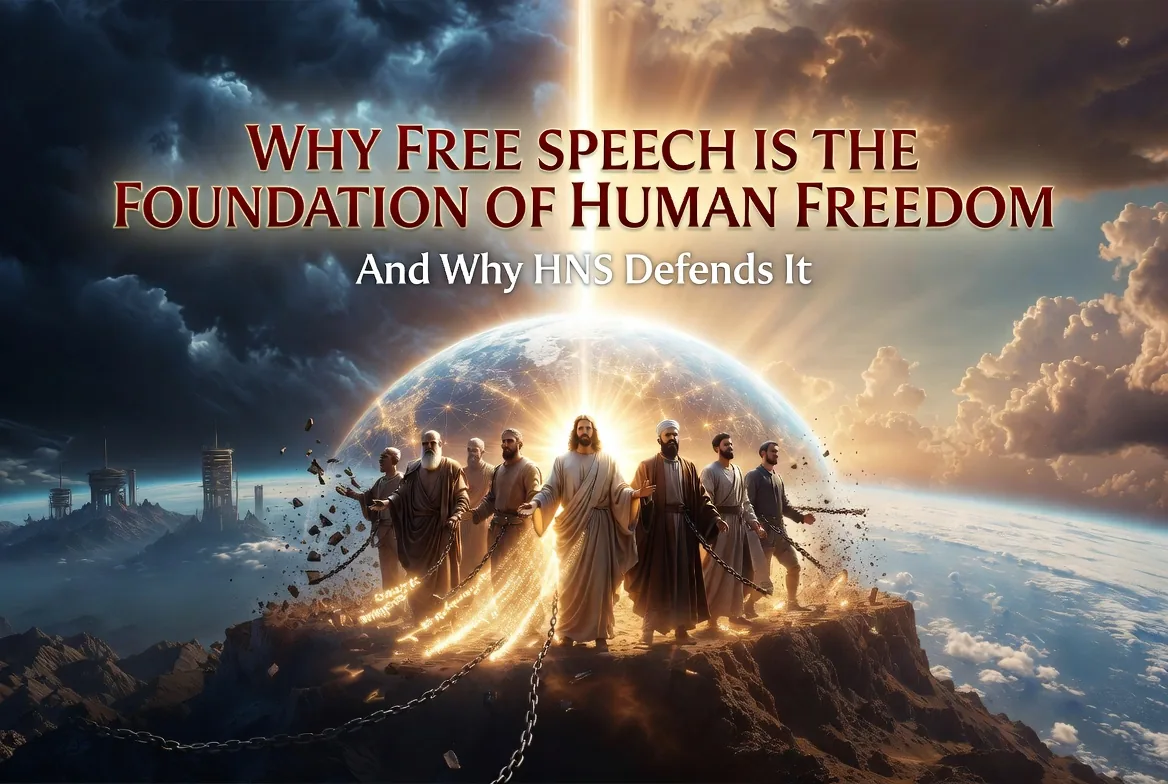
The history of free speech is the history of people who said what needed to be said — and the history of what was done to them for saying it. Jesus, Imam Ali, al-Husayn, Imam al-Baqir, Ibn Rushd, Socrates, Bruno, Galileo, and millions of unnamed others paid with their freedom or their lives for the simple act of speaking truth.
We inherit what they built. Every idea we hold freely, every argument we can make without fear, every article we can publish without government approval — these are gifts purchased by those who paid the highest price.
HNS carries their flag. Not because it has politics, not because it favors any ideology, but because the right to speak must never depend on the permission of power.
Build on HNS. Publish on HNS. Name on HNS. Not just because the technology is elegant — but because some things are worth protecting at the infrastructure level.
Published on LearnHNS.com — educational content about the Handshake decentralized naming protocol and its role in a freer internet.