

Let's start with something that will make you look at domain names differently forever.
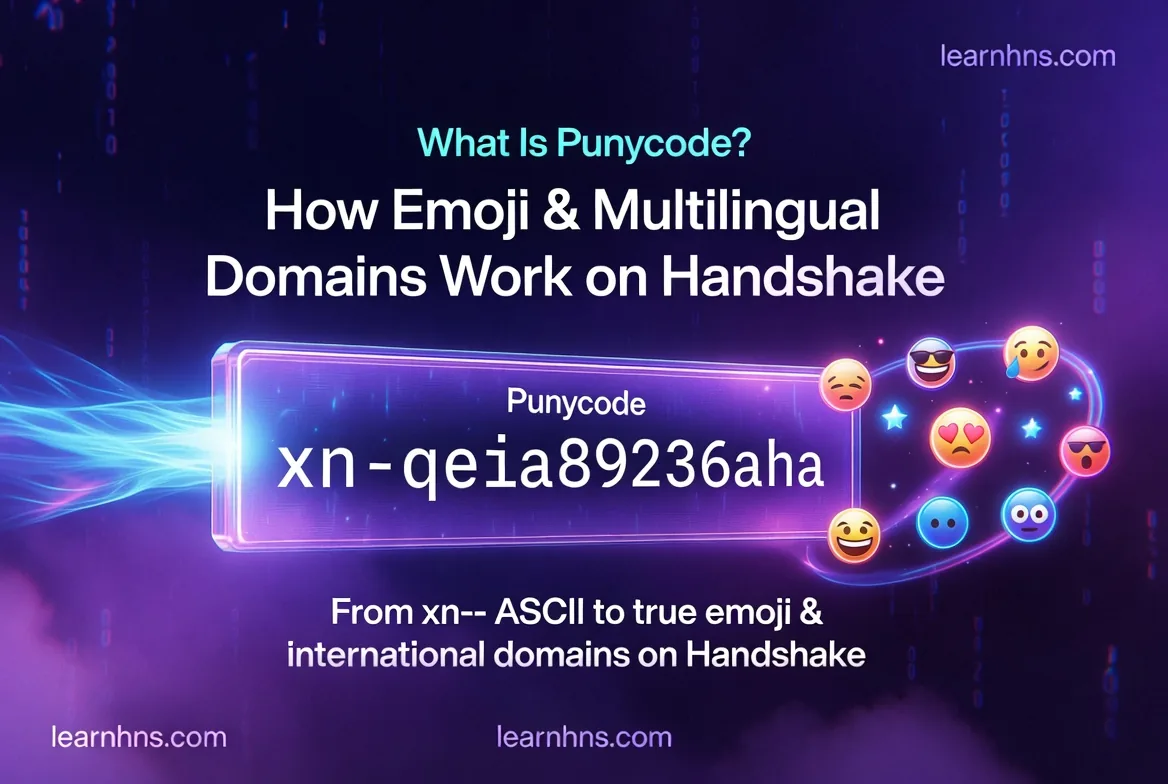
Type xn--qeia89236aha into a Handshake resolver. What you get back is this: ❤🇹🇷❤
A heart. A Turkish flag. Another heart. A fully functioning top-level domain on the Handshake blockchain — owned outright, permanently, by whoever holds the private key. No ICANN. No registrar. No annual fees. No permission from anyone.
That string of letters and numbers is called Punycode — and once you understand it, you'll understand something profound about how the internet works, why it was built to exclude most of humanity, and how Handshake is quietly fixing that.
The Problem: The Internet Was Built for English
When the Domain Name System (DNS) was designed in 1983, it was built around ASCII — a 128-character set that covers the English alphabet, digits, and a handful of symbols. That was fine for the researchers who built it. But it left out the billions of people who speak Arabic, Persian, Chinese, Turkish, Hindi, and hundreds of other languages.
The DNS can only handle ASCII characters. Punycode is an encoding that converts Unicode characters into the limited ASCII subset that DNS can handle, making internationalized domain names possible. Every Punycode-encoded domain label starts with the xn-- prefix.
That xn-- prefix is called the ACE prefix — ASCII Compatible Encoding. Whenever you see a domain starting with xn--, you're looking at a name that contains characters the DNS can't natively understand — and Punycode is the translation layer that makes it work anyway.
Unicode: The Universal Alphabet
Before we get into Punycode, we need to understand what it's encoding.
Unicode is the standard that assigns a unique number — called a codepoint — to every character in every writing system that exists. Every letter in every language. Every symbol. Every emoji. As of Unicode 15.1, that's 149,813 characters across 161 scripts.
The resolution and operation of internationalised domain names over the internet is possible because encoding protocols can convert the ever-growing number of Unicode characters into strings the DNS can handle.
So when you type ❤🇹🇷❤, your computer sees four Unicode codepoints:
U+2764— ❤ Heavy Black HeartU+1F1F9— 🇹 Regional Indicator Letter TU+1F1F7— 🇷 Regional Indicator Letter RU+2764— ❤ Heavy Black Heart
The combination of U+1F1F9 and U+1F1F7 produces the Turkish flag through Unicode's regional indicator mechanism — pairs of letters that map to ISO country codes. It's an elegant trick hiding inside a simple emoji.
How Punycode Works: The Translation
Punycode's job is to take those Unicode codepoints and translate them into something the 1983 DNS can swallow — pure ASCII.
The algorithm works in two phases. First, any plain ASCII characters in the label are kept as-is. Then the non-ASCII characters are encoded using a base-36 numeral system — digits 0–9 and letters a–z — with a compression mechanism that keeps common characters short.
The result for ❤🇹🇷❤ is: qeia89236aha
Add the ACE prefix and you get the full Handshake TLD: xn--qeia89236aha
You can verify this yourself in Python:
domain = "❤🇹🇷❤"
encoded = domain.encode("idna").decode("ascii")
print(encoded)  # xn--qeia89236aha

decoded = "xn--qeia89236aha".encode("ascii").decode("idna")
print(decoded)  # ❤🇹🇷❤
The ASCII representation starts with the prefix xn-- and is followed by the emoji-containing domain name encoded as Punycode. Each emoji has a unique Punycode representation — the same emoji always produces the same Punycode string, everywhere in the world.
Why ICANN Blocks Emoji Domains
Here's where it gets political.
There are two standards for how Unicode maps to DNS labels: IDNA 2003 and IDNA 2008. The newer IDNA 2008 standard is stricter — and it explicitly classifies emoji as DISALLOWED for registry-registered labels. IDNA 2008 has stricter rules; emoji are categorized as DISALLOWED or UNASSIGNED, meaning emoji domains are technically invalid under this standard.
This is why emoji domains are effectively banned at the ICANN level. Only a handful of TLDs — .ws, .tk, .to, and a few others — permit emoji domain registrations. And even when they're technically allowed, practically no standard browser implements emoji display in the address bar — if you type an emoji domain into Chrome, Safari, Firefox, or Edge, the address bar shows only the xn-- string.
ICANN's position is essentially: emoji are not a language, so we won't approve them. For the billions of people whose languages and scripts are also underrepresented on the traditional web, this gatekeeping is not abstract. It is personal.
What Handshake Changes
Handshake removes the gatekeeper entirely.
Because Handshake stores TLD ownership on a decentralised blockchain rather than in ICANN's centralised root zone file, anyone can register any valid Unicode label — including emoji — as a top-level domain. No approval process. No policy committee. No annual renewal.
As of 2025, only 151 IDN top-level domains exist across 23 scripts under the traditional DNS. That number reflects decades of slow, politically fraught ICANN approvals. On Handshake, by contrast, Arabic-script TLDs, Persian TLDs, Chinese ideograph TLDs, indigenous language TLDs, and emoji TLDs all exist and can be registered today — without asking permission from anyone.
The xn--qeia89236aha (❤🇹🇷❤) domain is a live proof of this. A Turkish community member — or any person anywhere — can claim a sovereign digital namespace that expresses their cultural identity in their own symbols, permanently, on-chain.
How to Actually Resolve Handshake Domains
This is the part most guides skip. Owning a Handshake name is step one. Actually browsing the Handshake web is step two — and it requires pointing your device to an HNS-aware resolver.
The easiest and most recommended way in 2026 is the SkyInclude Browser — a Chromium-based browser built by the Shadstone/SkyInclude team with a built-in HNS light node. No plugins to install, no DNS settings to change, no router configuration. Just download, open, and you're browsing the Handshake internet natively.
👉 Download SkyInclude Browser v0.1.16: github.com/shadstoneofficial/skyinclude-browser/releases/tag/v0.1.16
It works on Windows, Mac, and Linux. Because the HNS light node is baked in, the browser syncs directly with the Handshake blockchain — meaning when you type xn--qeia89236aha or any other HNS TLD into the address bar, it resolves on-chain, no middleman required.
SkyInclude explicitly warns that HNS.to is a highly insecure way of browsing Handshake domains and should only be used for demo or educational purposes — the SkyInclude Browser is the right tool for real, everyday HNS browsing.
Other resolution options for advanced users:
- Fingertip — a browser extension for Chrome/Firefox that adds HNS resolution without switching browsers
- Bob Wallet — the self-custodial HNS wallet that also runs a full node for the most decentralised resolution experience
- HNS.to — demo/educational use only; not secure for real browsing
The SkyInclude community at skyinclude.com is also the best place to ask questions, discover new HNS names, and stay current with everything happening in the ecosystem.
The Full Stack: How It All Connects
Here's how the five layers of a multilingual Handshake domain work together, from bottom to top:
Layer 1 — Network: A peer-to-peer network of Handshake nodes maintains the blockchain. No single server. No single country.
Layer 2 — Consensus: The Handshake blockchain records TLD ownership as a UTXO — the same model as Bitcoin. Your name is in your wallet. Lose the key, lose the name.
Layer 3 — Encoding: Punycode (RFC 3492) and Unicode (IDNA 2008) translate your emoji or multilingual name into an ASCII-compatible DNS label the resolver can process.
Layer 4 — Identity: Your Handshake name — xn--qeia89236aha — is your on-chain identity. It can point to a website, a wallet address, an IPFS site, or anything a DNS TXT record can carry.
Layer 5 — Application: The SkyInclude Browser, Fingertip, or Bob Wallet resolve your name and route users to whatever you've built beneath it.
A Few Things Worth Knowing
Homograph attacks are real. A domain that displays cleanly on one device may appear as Punycode on another, which affects trust and whether a user thinks the link is legitimate. Always verify the Punycode form of any unfamiliar domain.
Key management is everything. Unlike ICANN domains, there is no recovery mechanism for a lost Handshake private key. Use a hardware wallet and keep backups.
HNS.to is for demos only. HNS.to is a highly insecure way of browsing Handshake domains and should only be used for demo or educational purposes. Use the SkyInclude Browser for anything real.
Why This Matters
Approximately 3.5 billion internet users do not use Latin as their primary script. The traditional DNS was never designed with them in mind — and ICANN's slow, expensive approval process has not caught up in 40 years.
Handshake isn't waiting. By combining Unicode's universal character encoding with Punycode's ASCII bridge and a decentralised blockchain, it creates a naming system where any language, any script, and any emoji can become a sovereign top-level domain — owned permanently, controlled by no authority, and accessible to anyone with an HNS resolver.
The internet's next naming layer is being written not in ASCII — but in every script humanity has ever devised.
And in emojis that transcend language entirely. ❤🇹🇷❤
Concept research by Sina Khoshtarkib Zenoozi — Web3 Identity Research, May 2026. Ready to resolve Handshake domains? Download the SkyInclude Browser and start browsing the decentralized web today.