

Introduction: Trillions in Assets, and Nowhere to Put a Name
Real-world asset (RWA) tokenization is no longer a thought experiment. Real estate, treasury bonds, private credit, commodities, carbon credits, fine art, intellectual property, even individual shipping containers are being represented on-chain as tokens today. Forecasts from major banks and asset managers put the tokenized asset market in the trillions of dollars within the next decade. The technology to mint these assets — ERC-20s, ERC-721s, ERC-3643s, and a dozen other token standards — is mature and battle-tested.
But there's a problem nobody in the RWA conversation likes to talk about: a tokenized asset with no name is just a hexadecimal contract address and a token ID.
Ask a real estate investor to remember 0x9f2A...c81E, token #4471, on a specific chain, verified through a specific indexer. Ask an institutional allocator to explain to their compliance department why the "identity" of a $50 million tokenized bond is a string of characters with no root of trust. Ask a farmer in a supply-chain finance pilot to type that address into a phone correctly, every time, with zero tolerance for typos.
This is not a UX inconvenience. It's a structural gap. Every mature financial and legal system in history — land registries, ISIN codes for securities, VIN numbers for vehicles, DNS for the internet itself — has needed a human-readable, cryptographically verifiable naming layer before it could scale to mass adoption. Tokenized assets are no exception, and right now, most of the RWA industry is building skyscrapers without addresses.
This is exactly the gap Handshake TLDs and SLDs are positioned to fill.
What Handshake Actually Brings to the Table
Handshake is a decentralized, permissionless naming system — no ICANN, no central registry operator, no rent-seeking intermediary sitting between a name and its owner. When you own a Handshake top-level domain (TLD) like finance/, property/, or a custom TLD you've registered yourself, you don't lease it. You hold it, on-chain, the same way you'd hold any other digital asset. Second-level domains (SLDs) — the asset.yourfinancetld style names underneath a TLD — extend that same ownership model down to the individual record.
Three properties make this structurally suited to RWA identity, not just convenient:
1. Namespace ownership without a gatekeeper. A tokenization platform can own its own TLD outright — reit/, bonds/, carbon/ — and issue SLDs to represent individual assets under it, without asking permission from a registrar that could revoke it, censor it, or raise fees arbitrarily. For institutions putting real capital behind tokenized instruments, that's not a nice-to-have. It's a prerequisite for treating the naming layer as infrastructure rather than a rented service.
2. On-chain, verifiable resolution. A Handshake name resolves through the blockchain itself, meaning the mapping between a human-readable name and the underlying resource — a wallet address, a contract, a document hash, a DANE-secured certificate — is independently verifiable, not something you have to trust a corporate DNS provider to report honestly. For an asset whose ownership record needs to survive audits, due diligence, and cross-border legal scrutiny, that verifiability is the entire point.
3. Structural fit for hierarchical assets. RWA portfolios are naturally hierarchical: a fund holds properties, properties have units, units have tenants and liens. A single Handshake TLD can express that entire structure through nested SLDs — unit12.building7.reit — giving every layer of an asset's ownership stack its own addressable, resolvable identity instead of forcing everything into a flat list of token IDs.
Put simply: a token proves an asset exists and who owns it. A Handshake name lets a human, an auditor, or another system find, verify, and reference that asset without needing to understand blockchain internals first. Ownership and identity are different problems, and RWA tokenization has mostly solved only the first one.
Real-World Use Cases
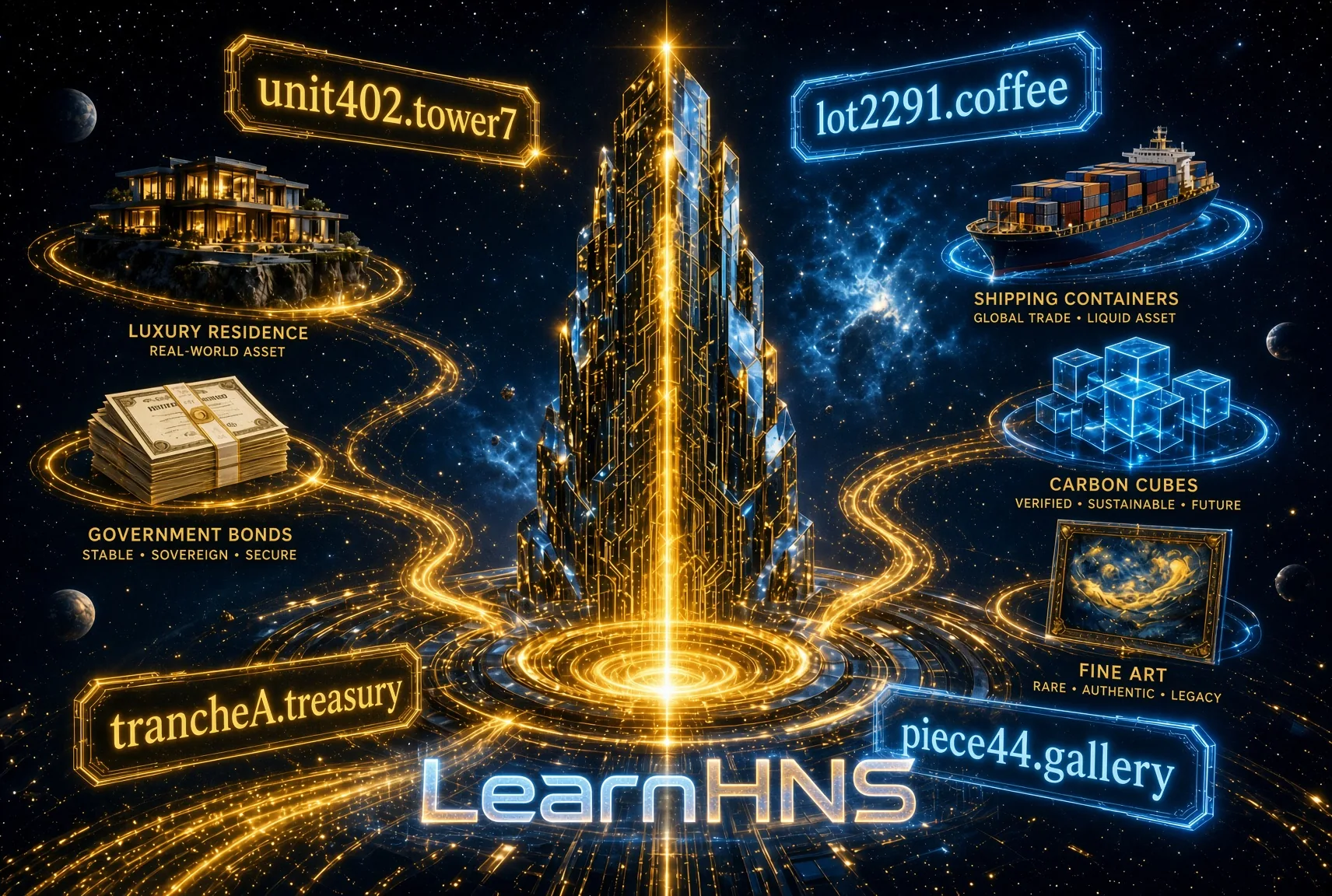
Tokenized real estate. A property developer tokenizing a residential tower could register a TLD like tower7/ and issue an SLD for every unit — unit402.tower7. Buyers, lenders, and title insurers reference one clean, memorable, verifiable name instead of a token ID buried in a block explorer. Ownership transfer, lien records, and rental income streams can all resolve from that same name.
Tokenized government and corporate bonds. ISIN codes exist precisely because bond markets needed human-parseable identifiers decades before blockchains existed. A tokenized bond issuance under a TLD like treasury/ or bonds/, with each tranche as an SLD, gives institutional desks a naming convention that maps naturally onto instruments they already understand, while adding on-chain verifiability ISINs were never designed to provide.
Supply-chain and commodity tokenization. A shipment of tokenized coffee, cotton, or copper moving through a supply-chain finance platform can carry an SLD like lot2291.coffee that resolves to custody records, certificates of origin, and financing liens at every step, giving lenders and customs authorities a single verifiable reference point instead of reconciling data across five disconnected systems.
Fractionalized art and collectibles. A fractionalized painting or rare collectible, tokenized into shares, can be addressed by a single memorable name — piece44.gallery — rather than requiring every fractional holder to track a contract address and index number to prove their stake.
Carbon credits and ESG assets. Carbon credit markets already struggle with double-counting and opaque registries. A TLD like carbon/ issuing an SLD per verified credit batch creates a naming layer that's independently checkable by any verifier, anywhere, without relying on a single registry's database integrity.
Agentic and automated finance. As AI agents increasingly execute trades, manage portfolios, and settle transactions on behalf of tokenized asset holders, those agents need machine-resolvable, tamper-evident references to the assets they're acting on. A Handshake name is exactly the kind of deterministic, on-chain-resolvable identifier that agent-to-agent finance will depend on — arguably even more than human users will.
Across every one of these cases, the pattern is identical: the token proves ownership; the Handshake name makes that ownership findable, referenceable, and trustworthy to anyone who needs to interact with it.
Looking Forward: Naming as the Missing Infrastructure Layer
The RWA tokenization narrative has, so far, been dominated by custody, compliance, and settlement — understandably, since those are the pieces regulators and institutions ask about first. But every naming system in history has arrived after the underlying asset class matured enough to need one, not before. Land didn't get formal registries until property markets outgrew informal record-keeping. Securities didn't get ISINs until cross-border trading made ad hoc identifiers unworkable. The internet didn't get DNS until IP addresses became too numerous to memorize.
RWA tokenization is at that same inflection point right now. As the asset side of this trend scales from pilot programs into trillions of dollars of real capital, the identity and naming layer underneath it will stop being optional. Handshake's TLDs and SLDs — decentralized, owned outright, verifiable on-chain, and structurally suited to hierarchical asset relationships — are one of the few naming systems built from the ground up for exactly this moment, rather than retrofitted onto it.
The tokenization race has largely been won on the technical layer. The naming and identity layer is still wide open. For builders, funds, and platforms thinking seriously about where RWA infrastructure goes next, that's not a gap to work around — it's a foundation worth building on now, while the namespace is still being claimed.
NIHON — Handshake Infrastructure & Web3 Identity