

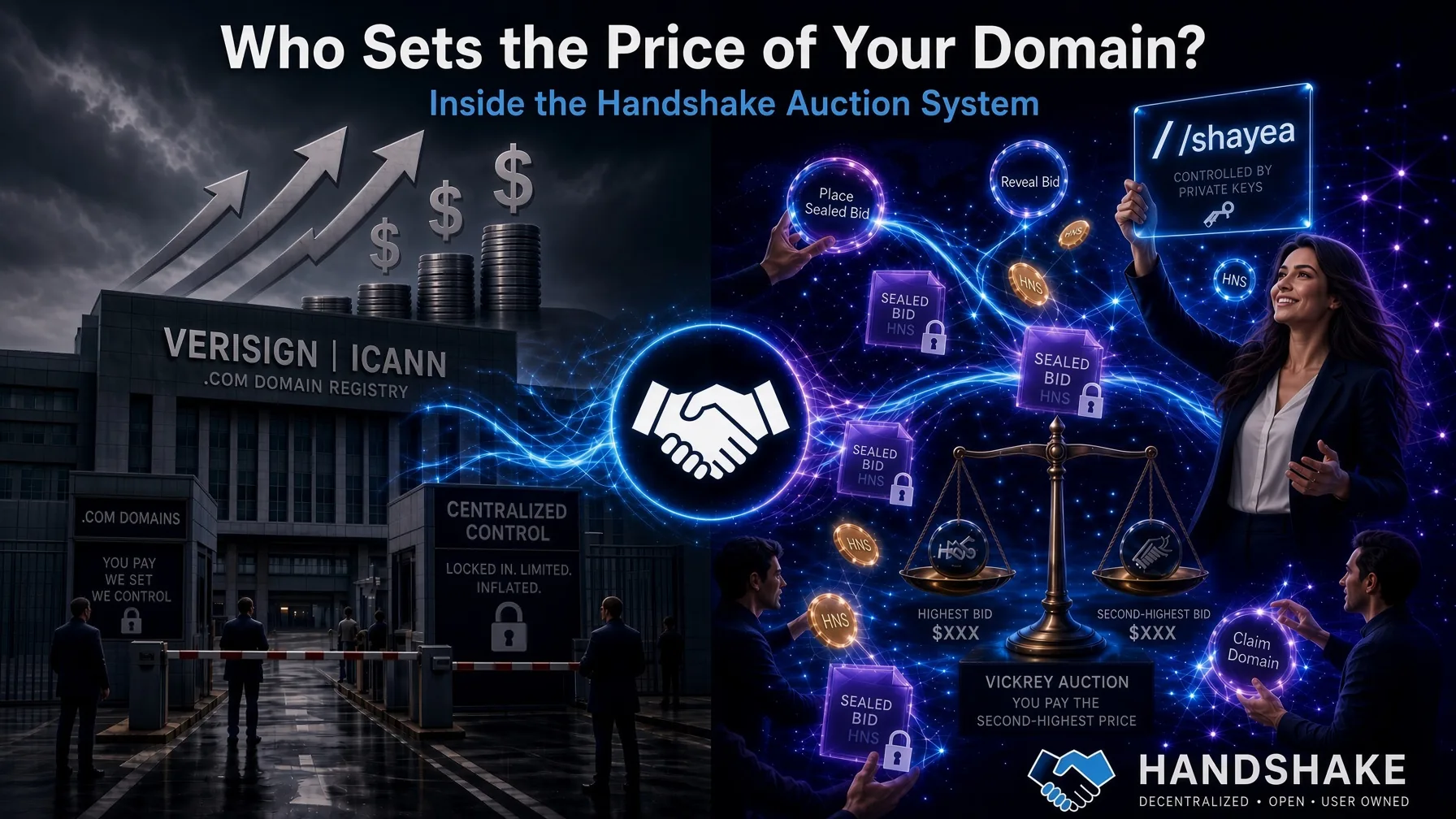
Every year, the price of a .com domain goes up. Not because demand changed. Not because a market decided it. Because Verisign is contractually allowed to raise wholesale .com prices by up to 7% a year during most years of its current agreement with ICANN — and ICANN itself has been raising its own per-domain fees on top of that. Registrars pass both increases straight to you at checkout.
Nobody voted on your domain's price. One company sets it, one non-profit approves it, and the rest of the internet pays it. That is not a market. That is a toll booth with a renewal date.
Handshake was built to answer a simple question: what if nobody got to set the price of a name? What if the price came from an actual auction, run by nobody, that anyone in the world could join? That system already exists, and it has been running since 2020. Here is exactly how it works.
Lesson 1: There Is No Auction House
With .com, ICANN accredits Verisign to run the registry. With Handshake, there is no company running the auctions. The auction logic is written directly into the blockchain's consensus rules — the same rules that every full node on the network enforces. Think of it like a vending machine bolted into a public square: nobody stands behind it collecting coins and handing out names. The machine itself is the rulebook, and thousands of independent computers around the world all check that the machine is being used correctly.
No company runs a Handshake auction. The chain runs it, block by block, and every full node checks the work.
Lesson 2: Anyone Can Open One
When a Handshake name (the equivalent of a TLD, like /shayea) is still available, anyone can send a small transaction that "opens" the auction for it. This isn't a request to a company — it's a transaction that gets mined into a block, and from that point on, the name is officially up for bidding. Think of it like sticking a "For Sale" sign on an empty plot of land that anyone can see and respond to. No landlord approves the sign going up.
Lesson 3: The Bidding Period — Bids You Can't See
Once opened, a 5-day bidding window starts. During this window, anyone can place a bid, but here's the twist: bids are blind. You don't send "I bid 50 HNS." You send a locked amount that hides your real bid inside it, along with an extra padding amount (the "blind bid" padding) that disguises how much of your transaction is the actual bid versus decoy.
It's like a silent auction where everyone drops a sealed envelope into a box, except the envelope itself is stuffed with extra blank paper so nobody can even judge your bid by the thickness of your envelope. Nobody, including other bidders, can see who's winning during this window.
Lesson 4: The Reveal Period — Opening the Envelopes
After bidding closes, a 10-day reveal period begins. Now every bidder must send a second transaction that unlocks their real bid amount and proves it matches what they originally committed to. This is the step people using Bob Wallet or the LearnHNS wallet tools sometimes forget — miss the reveal window, and your locked HNS is burned, not refunded. The chain doesn't forgive a missed deadline.
Lesson 5: The Vickrey Twist — You Don't Pay Your Own Bid
This is the part that surprises newcomers most. Handshake uses a Vickrey auction, also called a sealed-bid second-price auction. The highest bidder wins the name — but only pays the amount of the second-highest bid, not their own. If you bid 300 HNS and the next-highest real bid was 200 HNS, you win the name for 200 HNS and get the remaining 100 HNS back. If only one person bids, they win for 0 HNS (plus a small network fee) and get their entire bid refunded. This design, invented by economist William Vickrey, exists because it removes the incentive to sandbag your bid or guess what others might pay — your best strategy is always to bid what the name is genuinely worth to you.
Lesson 6: Losing Bidders Aren't Punished
Unlike a real-world deposit you might lose for losing an auction, Handshake returns essentially all of a losing bidder's locked HNS after the reveal period, minus a tiny mining fee. The padding is always returned regardless of outcome. This matters because it means small players can participate without real financial risk — a very different posture from a wholesale registry contract that only a handful of accredited companies can even bid on.
Lesson 7: Winning Isn't the End — It's Custody
Once you win, you don't get a certificate from a registrar. You get direct on-chain control of the name via your own private keys. From there, you send a REGISTER transaction to attach DNS records — the actual data (nameservers, TXT records, glue records) that makes the name resolve. You are the registry operator for your own name, permanently, as long as you keep renewing on-chain. There's no company that can suspend it, no monopoly registry that can hike your renewal fee 7% a year, and no ICANN approval layer in between.
If any of this still feels abstract, we broke the whole mechanism down in plainer terms here: How Blockchain Gives You a Name Nobody Can Steal: The HNS Auction Explained for Teenagers.
Why This Actually Matters
The .com price hikes aren't a bug in the legacy DNS system — they're the natural result of putting one company in charge of a resource everyone needs. Handshake's auction removes that chokepoint entirely. The price of a name isn't set by a boardroom; it's set by whoever else in the world wants it badly enough to bid. That's a genuinely different economic model for how naming infrastructure works, and it's worth understanding even if you never bid on a name yourself.
To actually see resolved Handshake names in a browser without running your own full node, use SkyInclude Browser or the DANE HNS Browser — these are the only resolution paths we recommend at this stage of the ecosystem.
NIHON — Handshake Infrastructure & Web3 Identity