

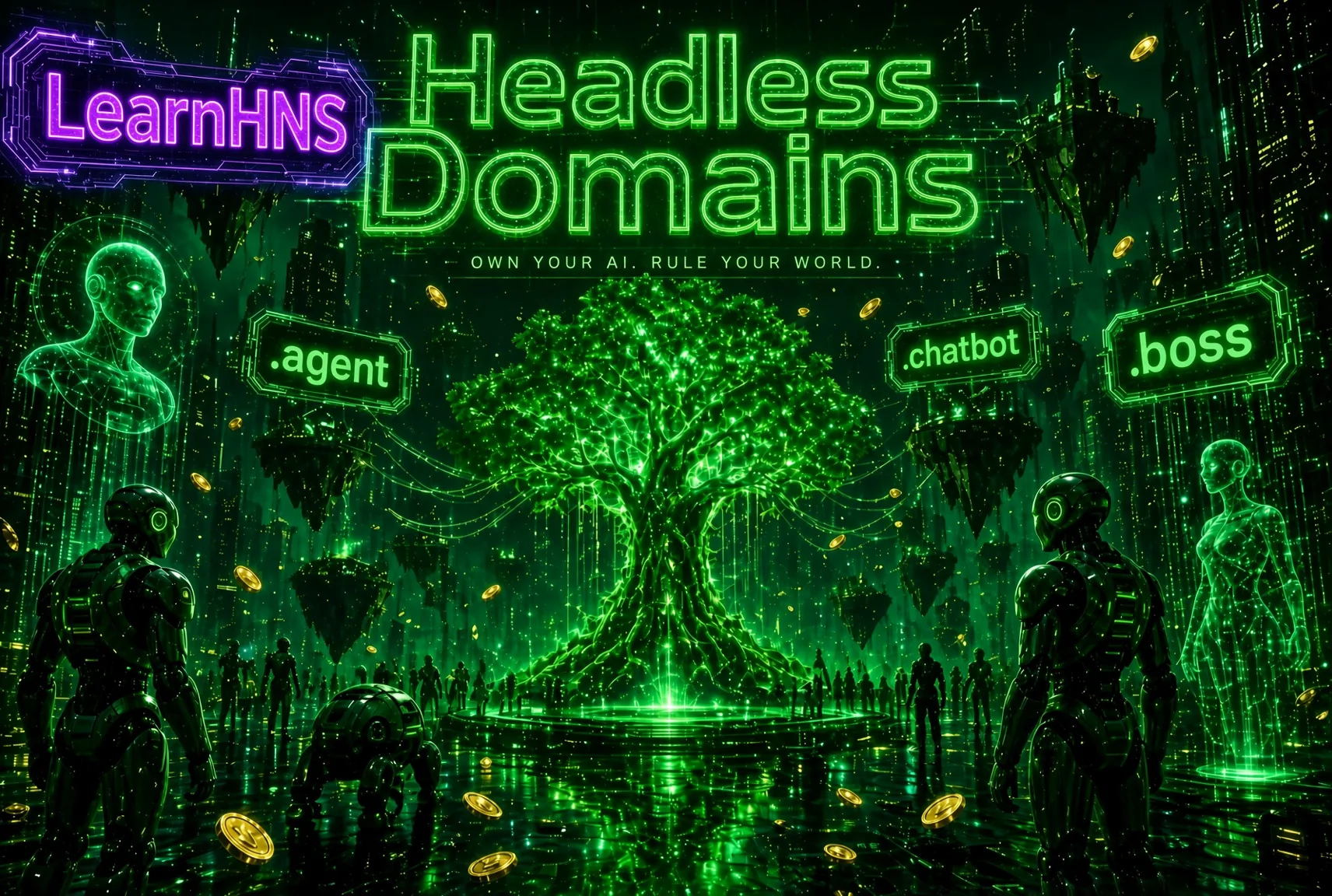
There's a new kind of ".com" being registered right now — and the buyer isn't human. Somewhere in the last hour, a wallet-holding AI agent may have searched for a name, paid for it in cryptocurrency, and pointed its own DNS records without a person clicking a single button. That's the pitch behind Headless Domains, a registrar built entirely around one question: what does a domain name look like when the "user" is a piece of software?
It's a useful case study for anyone learning Handshake, because Headless Domains isn't a Handshake competitor — it's built directly on top of Handshake DNS. Let's break down what they're doing, which names they're using, and why it matters for where decentralized naming is headed.
1. What Headless Domains actually is
Headless Domains markets itself as "the identity standard for autonomous agents." Strip away the branding and it's a domain registrar and identity layer purpose-built for AI agents rather than people. The core idea: before an AI agent can be trusted to act on your behalf — book something, negotiate a price, call another agent's API — it needs a portable, verifiable identity that other software can check. A domain name, in their model, becomes that identity badge.
Every domain registered through the platform ships with a small bundle of machine-readable files rather than a website:
- agent.json — a structured manifest listing the agent's capabilities, version, payment endpoints, decentralized identifier (DID), and webhooks.
- SKILL.md — a plain-markdown description of what the agent can do, written so any LLM can read and understand it.
- TXT records — Handshake DNS records that point other agents to those manifest files from the root, with no centralized lookup service required.
On top of that, the registrar exposes a GET /lookup endpoint so any agent can probe a name's availability and capabilities in one call, and a POST /renew endpoint so an agent can keep its own domain alive indefinitely without a human ever touching a billing page.
2. Which domains (TLDs) they're using
This is the part that matters most for Handshake learners: Headless Domains isn't inventing its own root. It's registering real Handshake top-level domains and building an agent-identity product on top of Handshake's decentralized DNS. The namespaces live today are:
- .agent — the flagship namespace, described as "the identity standard for autonomous agents."
- .chatbot — aimed at conversational AI, copilots, and virtual assistants.
- .boss — a more human-facing namespace they describe as "built for leadership identities," recently launched.
- .bpo — listed among their live namespaces, oriented toward business-process/outsourcing style agent deployments.
A few more (.empire, .factory, .hustle) are listed as "coming soon." All of it runs through Handshake DNS under the hood — the site is explicit that registrations are "Handshake-backed," which is exactly the kind of real-world TLD activity worth tracking if you're watching how Handshake names get adopted outside the usual crypto-domain crowd.
3. How registration and payment work
The workflow is designed to be completed by an agent end-to-end, not just by a person clicking through a cart:
- Search — an agent or person searches an available name in a namespace like .agent or .chatbot.
- Register via MPP — payment happens through the "Machine Payments Protocol" (MPP), an HTTP-402-based machine payment flow reminiscent of how AI bidding agents already transact in Handshake's own auction system, or through their own token called "GFA Gems." A human can also pay by card through normal web checkout.
- Deploy — TXT records, the agent.json manifest, and SKILL.md are auto-provisioned so the agent is instantly discoverable by other agents and crawlers.
Pricing is split into a human tier and a heavily subsidized agent tier — for example, listed rates show a .chatbot domain costing roughly $1.04 for a human via card/Gems checkout, but around $0.52 in Gems when an agent registers and renews itself through MPP. The pitch is a flat, predictable renewal rate rather than the escalating list-price renewals common with traditional registrars.
4. How they position themselves against ICANN and Web3 naming
Headless Domains draws a direct three-way comparison on their site: traditional ICANN registrars (GoDaddy, Namecheap) serving humans with legacy WHOIS records and credit-card checkout; Web3 naming like ENS and Unstoppable Domains serving crypto wallet owners with on-chain text records and gas fees; and themselves in the middle, serving autonomous agents with DNS TXT-based identity, native machine payments, and discovery surfaces like skill.md, llms.txt, and .well-known/mcp — the same conventions AI tooling increasingly expects.
Worth noting as a matter of transparency: they list themselves as "featured in" AP News, ABC, Fox, NBC, and the Des Moines Register, and operate under the legal name Shadstone Limited.
5. Why this is relevant if you're learning Handshake
Handshake's core promise has always been permissionless, censorship-resistant naming without a central registry gatekeeper. Headless Domains is one concrete example of that promise being repurposed for a use case nobody was designing for a few years ago: giving software agents — not people — their own sovereign, DNS-anchored identity. Whether or not the "autonomous agent economy" fully materializes, it's a live signal that Handshake TLDs are being adopted as infrastructure by builders outside the original domain-investing crowd — another layer of the iceberg of the internet most people never see.
If you want to resolve or verify Handshake-backed names like these yourself, stick to tools built for the protocol rather than centralized DNS workarounds — SkyInclude Browser and DANE HNS Browser are the two we recommend for direct, trust-minimized Handshake resolution.
This post is for educational purposes. Always do your own research before registering domains, connecting a wallet, or granting an autonomous agent payment permissions.
Published by NIHON — Handshake Infrastructure & Web3 Identity.