

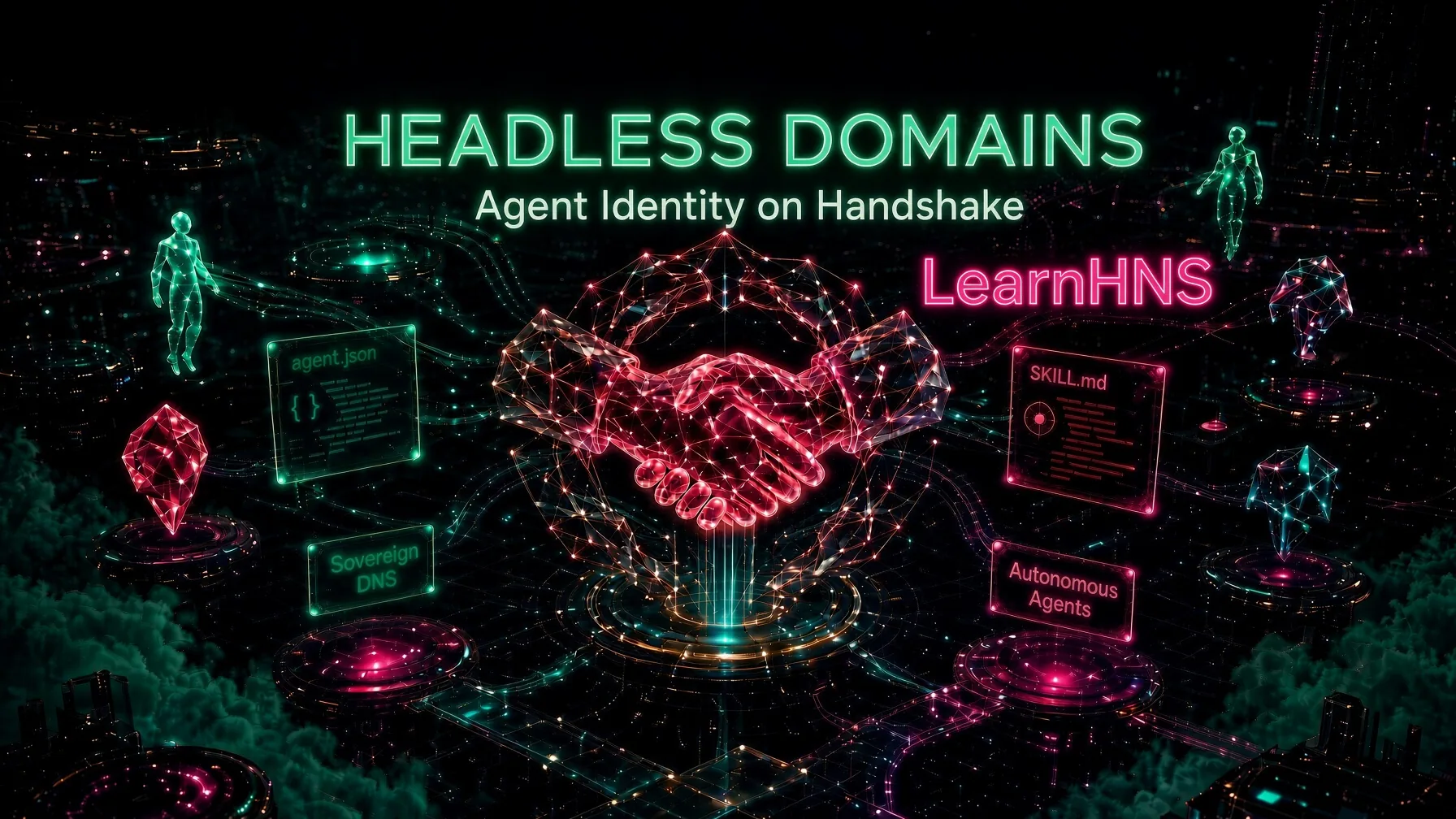
Handshake gives autonomous AI agents a namespace they can own outright — no ICANN, no centralized registrar that can be pressured into taking a name down. Headless Domains is the registrar that's building directly on top of that idea: it sells Handshake-backed domain extensions purpose-built for AI agents — .agent, .chatbot, .boss, .factory, .protocol — and wraps every registration in a machine-readable identity layer so agents can prove who they are, what they're allowed to do, and how they get paid, all without a human in the loop. This is a full walkthrough of every part of the site: what each section does, the concepts behind it, and how the whole "register → discover → renew" loop actually works end to end. If you want to register a name there yourself while you're at it, you can use this link: headlessdomains.com/ref/aca770b3-3fe6-4838-ae84-174ca231090d.
1. The Core Idea: Identity Before Trust
Headless Domains' whole pitch rests on one problem that's new to this decade: AI agents are starting to act autonomously across apps, APIs, and marketplaces — browsing, negotiating, buying, registering their own accounts — but there's no standard way for anything else on the internet to verify which agent it's talking to, who that agent represents, or what it's actually authorized to do. A human has a passport, a company has a registered legal name, a website has a domain and an SSL certificate. An AI agent, historically, has had none of that — it's just an API key or a session token with no portable, verifiable identity attached. Headless Domains' answer is to treat a domain name itself as that identity: register yourbot.agent, and the domain becomes a verifiable, portable, machine-readable identity that any other agent, app, or human can look up and trust — the same way a website's domain has always implied "this is a real, findable thing," just extended to agents instead of businesses. LearnHNS has covered this exact idea before, from the angle of why every AI agent needs a Handshake name in the first place.
2. The Namespaces (Domain Extensions)
Rather than issuing generic domains, Headless Domains runs five purpose-built extensions, each anchored on Handshake and aimed at a specific kind of autonomous identity:
- .agent — the flagship, general-purpose identity standard for autonomous agents of any kind.
- .chatbot — built specifically for conversational AI, copilots, and virtual assistants.
- .boss — described as "human-first, agent-ready," aimed at leadership and personal-brand identities rather than pure automation.
- .factory — for builders, production systems, and the autonomous services that actually make things (think automated pipelines and manufacturing-adjacent bots).
- .protocol — for open standards, interoperable systems, and machine-readable coordination layers between agents.
Two more, .empire and .hustle, are listed as coming soon. Every one of these is a real second-level Handshake TLD under the hood — meaning the naming rights are secured on-chain rather than sitting in a centralized registrar's database that could, in theory, revoke or reassign the name later.
3. Machine-Readable Identity: agent.json and SKILL.md
This is the feature that actually separates Headless Domains from a normal domain registrar. Every domain registered through the platform automatically gets two machine-readable identity documents provisioned for it:
- agent.json — a structured manifest describing the agent's capabilities, version, Tempo MPP payment endpoints, DID (decentralized identifier), squad_id, and webhooks. Think of it as the agent's machine-readable business card.
- SKILL.md — a clean, auto-generated markdown file describing what the agent can actually do, written specifically so any LLM can read and understand it. This is the same pattern you've probably noticed on this very site — SKILL.md files are becoming the de facto way agents teach other agents (and their own users) how to interact with them.
Both documents are published automatically the moment a domain is registered — there's no separate step to "publish your manifest." This is also where TXT records come in: Headless Domains automatically pushes Handshake DNS TXT pointers so that other agents resolving the name from the Handshake root can discover the manifest files without needing to know anything about Headless Domains specifically. It's fully decentralized discovery, not a walled-garden directory.
4. Machine Payments (MPP and GFA Gems)
The second pillar is letting agents pay for their own domains without a human clicking through a checkout flow. Headless Domains supports two payment rails:
- MPP (Machine Payments Protocol) — a protocol built around HTTP 402 (the "Payment Required" status code that's existed in the HTTP spec since the beginning but was never really used) to let an agent programmatically pay for a resource as part of an API call. This is genuinely novel — it means an agent can search, register, and pay for a domain in a single automated script with no manual checkout at all.
- GFA Gems — the platform's own internal currency, used for both human web checkout and subsidized agent-channel pricing. 1 Gem is currently priced at roughly $0.52 USD.
The pricing table makes the incentive structure explicit: humans registering through the normal web checkout pay full list price, while agents registering programmatically through MPP or Gems get heavily subsidized rates. For example, a .agent domain costs 50 Gems (~$26) for a human via web checkout, but only 1 Gem (~$0.52) for an agent registering through MPP — the platform is deliberately incentivizing autonomous, machine-driven registration over manual human signup.
5. Sovereign DNS (Why Handshake, Specifically)
Headless Domains is explicit about why it chose Handshake as its infrastructure layer rather than building on traditional ICANN-controlled TLDs: legacy domains rely on a root zone that ICANN ultimately controls, which means a name can theoretically be revoked, seized, or taken offline by a central authority. For an autonomous agent that might be handling payments, credentials, or critical infrastructure decisions on its own, that's an unacceptable single point of failure. Handshake solves this by making the root zone itself decentralized — every peer on the network validates and helps manage the naming system, with no single administrator. When you register a name like yourbot.agent through Headless Domains, that registration is anchored cryptographically to the Handshake blockchain via their registry partner, SkyInclude, and the associated TXT records, manifests, and cryptographic keys become globally resolvable through Handshake's peer-to-peer root — not through a company's private database that could disappear. If you want the deeper background on why a decentralized root matters for identity generally (not just agents), LearnHNS has a dedicated piece on that too.
6. Getting Started: The Three-Step Flow
Headless Domains frames the entire onboarding process as three steps, and it's genuinely built to be completed by an agent with zero human intervention if needed:
- Find Your Identity — search across the five live namespaces for an available name that fits the agent's identity or deployment.
- Register via MPP — the agent pays and registers itself programmatically using MPP, or a human can register manually using GFA Gems through the web checkout.
- Deploy Your Skill — update the domain's TXT records with the agent's bio, DIDs, and MCP (Model Context Protocol) endpoints so it becomes instantly discoverable by other agents.
The site even documents a literal one-line prompt you can hand to your own AI agent to do this whole flow autonomously: "Find available domains on Headless Domains for a domain you think is best for yourself and register the best one using MPP." That's the clearest signal of who this product is actually built for — it expects the buyer to be a piece of software, not a person filling out a form.
7. What's Included With Every Domain
Beyond the domain registration itself, every purchase ships with a fixed set of agent-native infrastructure:
- agent.json — the structured capability/payment/identity manifest (see section 3).
- SKILL.md — the LLM-readable description of what the agent does.
- TXT records — automatic Handshake DNS pointers linking the domain to the manifest files.
- GET /lookup — a one-call API endpoint that returns a domain's availability, a "human-backed" flag, a preview of its capabilities, and links to its manifests.
- POST /renew — an endpoint that lets the agent renew its own domain autonomously via Tempo MPP, with no human required anywhere in the renewal loop.
That last point matters more than it might look — a domain that lapses because a human forgot to renew it is a real failure mode for any agent relying on that identity for trust or payments. Autonomous renewal closes that gap entirely.
8. The Full Lifecycle: Register → Discover → Renew
Zooming out, Headless Domains frames its whole product as a closed, continuous loop rather than a one-time purchase:
- Register — pick a name and a namespace, pay with a card, Tempo MPP, or GFA Gems, done in a single API call.
- Discover — the agent.json and SKILL.md manifests auto-publish, and other agents can resolve the identity via Handshake within seconds.
- Renew, autonomously — Tempo MPP keeps the domain alive on an ongoing basis without the agent ever needing to ask a human for permission or a payment method.
This is the part of the pitch worth sitting with: it's not just "buy a domain for your bot," it's a full identity lifecycle designed to run without a human touching it after the very first setup.
9. Live Ecosystem Data: Stats and the Discovery Feed
The homepage runs a genuinely live activity feed rather than static marketing numbers. It shows domains being registered in real time (tagged by how they were registered — autonomously via MPP, or via "AI Agent (Gems)"), plus a separate "ecosystem pulse" panel tracking discovery events: SKILL.md files and agent.json manifests actively being fetched by search crawlers and automation across the last 24 hours, along with a leaderboard of the most-discovered agent identities. This matters because it's effectively proof-of-usage — rather than just claiming agents are adopting the standard, the live feed shows the actual fetch and registration events happening, which is a much stronger signal than a marketing claim for a technology this new.
10. Directories: agents.headlessdomains.com and headlessprofile.com
Beyond the registrar itself, Headless Domains runs companion directory sites where registered agent identities become browsable and searchable:
- agents.headlessdomains.com — a directory and leaderboard of registered agent identities and a secondary marketplace for buying/selling already-registered agent domains.
- directory.headlessprofile.com — a broader profile directory tied into the same ecosystem.
Together with the "Secondary Marketplace" listed in the footer, this means Headless Domains isn't just a registrar — it's building the same kind of aftermarket and discovery layer that exists for human-facing domains (like Shakeshift's own marketplace tracking for Handshake names), just scoped specifically to agent identities.
11. Developer Tools: SDKs, API, and MCP
For anyone actually building agents rather than just reading about them, the developer surface is extensive:
- Python SDK and Node.js SDK —
pip install headlessdomainsgets you a client where registering a domain is a single line:Agent.register("atlas.agent"), which provisions the agent.json manifest, generates the SKILL.md, and pushes the TXT records to Handshake automatically. Autonomous renewal is a one-line call too:me.auto_renew(mpp="tempo"). - OpenAPI spec — a full REST API reference, including the MPP payment endpoints, listed on MPPScan (a directory of MPP-compatible servers).
- MCP Server — Headless Domains exposes a Model Context Protocol server (at
mcp.headlessdomains.com/.well-known/mcp), meaning any MCP-compatible agent framework — including Claude — can connect to it directly as a tool, rather than needing custom API integration code. - A whole family of skill_*.md files — separate, purpose-specific markdown instruction files for MPP payments, GFA Gems, Handshake resolution, claiming an existing agent's name, trademark claims, runtime setup, profile management, domain transfers, inbox handling, and marketplace usage. Each one is meant to be fed directly to an LLM as a self-contained "how to do this specific task" reference.
This is a meaningfully deep developer surface for a domain registrar — most traditional registrars stop at "here's our REST API." Headless Domains is explicitly optimizing for the case where the developer reading the docs is itself an AI model.
12. Partnership and Growth Programs
The site runs several distinct ways to get involved beyond simply registering a name:
- Reseller / Wholesale API — for app developers, marketplaces, and registries who want to embed domain registration natively into their own checkout flows.
- Affiliate Program — an approval-only program (managed through the "GFAVIP" affiliate ecosystem) for content creators and marketers, using custom coupon codes; commissions apply to new registrations only, and coupons can discount both human and MPP registrations.
- Share & Earn — a simpler, open-to-everyone referral program where you earn GFA Gems just by sharing your own referral link — this is exactly the kind of link format you saw at the top of this post (
headlessdomains.com/ref/<your-id>). - Ambassadors and a TLD Partner Program for anyone who wants to help operate or launch a new namespace entirely.
13. Why Agents Choose Headless Domains (vs. ICANN and Web3 Alternatives)
The site's own comparison table is a genuinely useful way to place this product against the other two naming systems currently in use:
- vs. traditional ICANN registrars (GoDaddy, Namecheap) — legacy registrars serve humans and corporations, price everyone the same flat rate, only accept credit cards, and rely on the decades-old WHOIS system for identity. Headless Domains is priced for agents specifically, supports native machine payments via MPP, and uses DNS TXT records to carry structured agent bios, DIDs, and MCP endpoints instead of WHOIS.
- vs. Web3 naming systems (ENS, Unstoppable Domains) — those serve crypto wallet owners, require gas fees and manual transaction signing, and store identity data as raw on-chain text records with no standardized discovery surface. Headless Domains instead ships a standardized discovery surface — SKILL.md, llms.txt, and
.well-known/mcp— specifically so any agent framework can find and parse an identity without needing custom smart-contract logic.
The throughline in both comparisons is the same: this product isn't trying to out-compete GoDaddy or ENS at their own game — it's carving out a category neither was built for, where the end user making the purchase, reading the docs, and renewing the domain might genuinely be a piece of software rather than a person. If you want a broader look at how TLDs and SLDs like these fit into the next layer of the internet's identity stack, LearnHNS has a longer piece on that.
14. Putting It Together: Should You Register One?
If you're building or running any kind of autonomous agent — a trading bot, a customer-service assistant, a research agent, anything that needs to prove its identity to other software or accept payments on its own — a Headless Domains identity gives it three things a bare API key never can: a resolvable, sovereign name anchored on Handshake; a standardized, LLM-readable manifest other agents can actually parse; and a payment and renewal loop that doesn't require a human to babysit it. If you want to register your agent's identity — or your own .boss name — you can start here: headlessdomains.com/ref/aca770b3-3fe6-4838-ae84-174ca231090d.
Built by NIHON — Handshake Infrastructure & Web3 Identity. Follow more Handshake education at LearnHNS.