

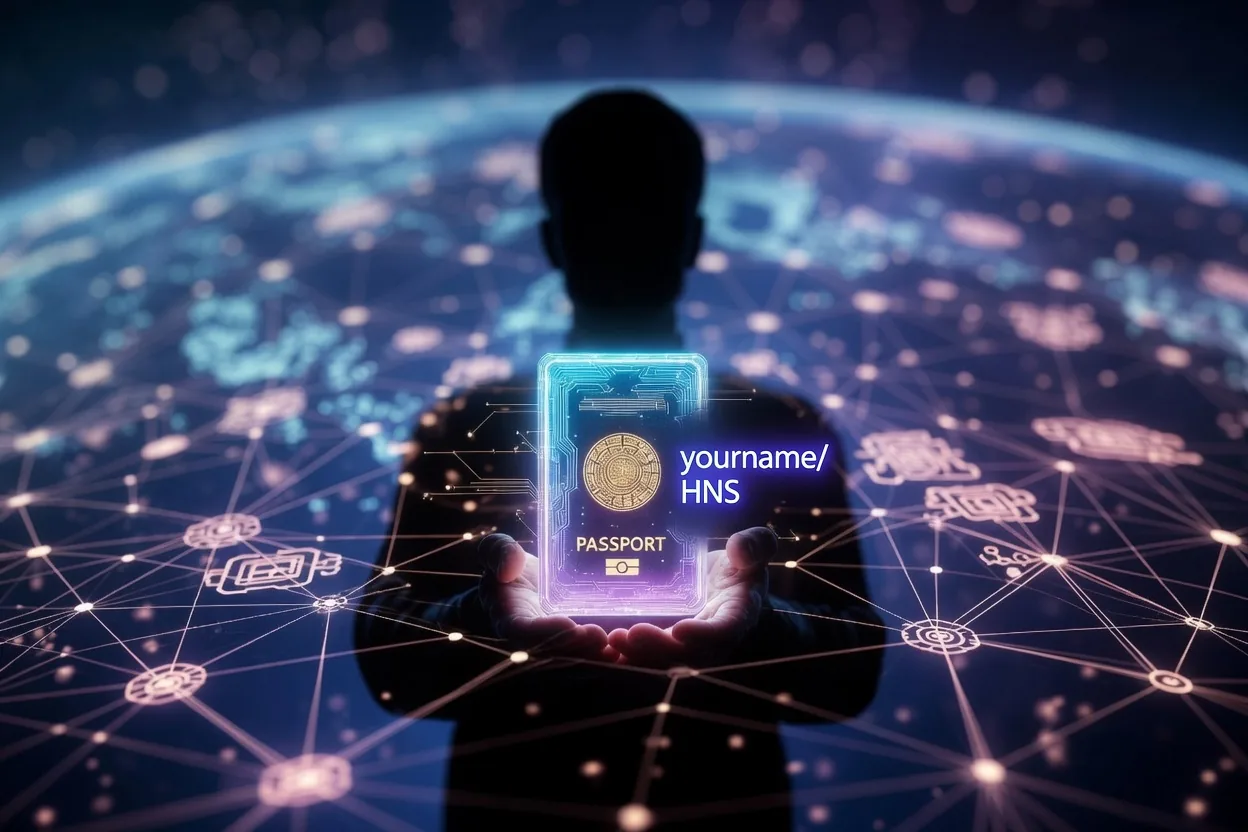
The Problem With Identity Today
Right now, your identity is scattered across dozens of systems that do not talk to each other. Your LinkedIn profile proves your work history — until LinkedIn suspends it. Your university diploma lives in a PDF someone could fake. Your government-issued ID is a physical card that crosses borders awkwardly and expires. Your KYC verification was done three times this year for three different platforms, and none of them shared results.
None of these systems are yours. They are all rented. Every institution holds a copy of their version of you — and they can revoke, suspend, or modify that version whenever they want.
There is a better model. It starts with a name you own on-chain.
What Is a Universal Digital Identity — and Why Does HNS Enable It?
A universal digital identity is a single, verifiable anchor point that represents you across all platforms, borders, and use cases. It should work for your professional credentials, your KYC records, your civic identity, your communications — everything. And critically, it should be owned by you, not by any company or government.
Handshake (HNS) is uniquely positioned to be that anchor for one simple reason: you own the top-level domain itself.
When you win a Handshake auction for a name — say yourname/ — you do not have a subscription. You do not have an account with a registrar who can cancel you. You hold a private key that proves ownership of that TLD on a public, immutable blockchain. That is a fundamentally different kind of ownership from anything Web2 offers.
How It Works: One TLD, Every Layer of Your Identity
Think of your HNS TLD as the root of a tree. Every branch is a different context of your life, all cryptographically tied back to the same verifiable root.
Layer 1 — Your Public Profile
Your HNS TLD resolves to a page that is your permanent home on the internet. Not a social media profile that disappears if a company folds. Not a link in a bio. A real web address — yourname/ — that you control at the DNS level, pointing to wherever you want, forever.
Layer 2 — Professional Credentials
Subdomains become credential containers. resume.yourname/ can host a verifiable CV. certifications.yourname/ can point to on-chain proofs of your qualifications issued by universities, training programs, or professional bodies. Because the subdomain is controlled by the same private key as the root TLD, anyone verifying your credentials knows they came from the same authentic source — you.
Layer 3 — KYC Once, Use Everywhere
This is one of the most powerful ideas in the HNS identity stack. Today, you prove your identity repeatedly — to banks, exchanges, DeFi platforms, government portals. Each one runs its own verification. Each one stores its own copy of your documents.
With HNS, you could complete a single high-standard KYC process and anchor the result to your TLD as a verifiable credential. Any platform that accepts HNS-anchored KYC can verify you instantly without you uploading your passport again. The credential is issued once. The trust is portable.
Layer 4 — Communications
mail.yourname/ can point to a decentralized email or messaging endpoint. Your contact address becomes permanent and unhackable at the DNS layer — because the DNS record itself is on-chain and can only be changed by your private key.
Layer 5 — Civic and Government Use
Governments are moving toward digital identity wallets. The EU's eIDAS 2.0 framework requires every member state to deploy a digital identity wallet by end of 2026. The UK's Border 2025 strategy has already moved to biometric digital credentials at border control. These are centralized systems today — but the model they are implementing is exactly what HNS was built to do, decentralized and without a single point of failure.
An HNS TLD can be the sovereign layer underneath any civic credential — a permanent, user-owned anchor that governments or international bodies can issue credentials to, rather than identity that lives inside their own siloed databases.
The Passport Analogy — and Why HNS Goes Further
A physical passport does one thing: it proves your nation-state has vouched for you. It works at borders. It expires. It can be revoked. It exists in one physical copy that can be lost or stolen.
An HNS-based digital passport does far more:
- It never expires — as long as you hold your private key, your TLD is yours.
- It cannot be revoked by a third party — no government or corporation can cancel your on-chain TLD.
- It is multi-dimensional — it can carry professional credentials, KYC attestations, civic records, and communications endpoints simultaneously.
- It is globally verifiable — anyone with access to an HNS resolver can verify the authenticity of any credential anchored to your TLD, without calling a central registry.
- It crosses borders natively — a credential on a blockchain has no jurisdiction. It is readable anywhere in the world with internet access.
Real-World Use Cases — Who Needs This Now
The Freelancer Working Across Borders
A software developer in Istanbul wins a contract with a company in Singapore. The company needs to verify her identity, her qualifications, and run a KYC check. Today, that process involves emails, PDF uploads, a third-party verification service, and two weeks of waiting. With HNS, her credentials are anchored at hername/, verifiable in minutes, from anywhere.
The Stateless or Displaced Person
Millions of people worldwide lack reliable government-issued identity. Refugees, stateless persons, and citizens of collapsed states cannot open bank accounts, access services, or prove their qualifications because the institution that would verify them no longer functions. An HNS TLD exists independently of any nation-state. International aid organizations, NGOs, or decentralized identity networks could issue credentials directly to a person's HNS TLD — permanently and without requiring government backing.
The Professional With Multi-Country Credentials
A doctor trained in Egypt, licensed in Germany, and practicing in Canada currently navigates three separate credential systems. With HNS, all three licensing bodies could issue verifiable credentials to the same TLD root. One check. Full picture.
The Web3 Builder
A developer building on multiple blockchains needs a single identity that works across Ethereum, Solana, Bitcoin, and HNS itself. An HNS TLD can hold wallet addresses, GitHub credentials, protocol contributions, and DAO voting records — all under one verifiable name.
The Technical Foundation: How HNS Makes This Trustworthy
The reason HNS can serve as an identity layer is not philosophical — it is technical.
Proof of Work consensus means the HNS blockchain is secured by real computational work, making it expensive to attack or rewrite. Your identity record on HNS is backed by the same security model as Bitcoin.
On-chain name ownership means TLD ownership is recorded as a UTXO (Unspent Transaction Output) on the blockchain — the same model Bitcoin uses to record who owns which coins. You own your name the same way you own your Bitcoin.
DNS-native design means HNS does not invent a new protocol from scratch. It extends the existing DNS system. Your HNS TLD can carry real DNS records — A records, TXT records, TLSA records — which are the standard containers for cryptographic identity proofs already used in DNSSEC, S/MIME, and certificate transparency.
No central CA means there is no Certificate Authority that can issue a fraudulent certificate for your domain or revoke your certificate under pressure. You are the CA for your own TLD.
What Still Needs to Be Built
This vision requires infrastructure that is still being developed. To make HNS function as a universal digital passport at scale, the ecosystem needs:
- HNS-compatible credential issuers — universities, governments, and professional bodies that issue W3C Verifiable Credentials anchored to HNS TLDs
- Resolver adoption — more browsers, wallets, and applications need to resolve HNS natively without requiring a separate extension
- KYC attestation standards — a shared standard for what a "KYC credential on HNS" looks like, so platforms can trust and read it uniformly
- Recovery mechanisms — solutions for key loss, since unlike a forgotten password, a lost HNS private key means permanent loss of the TLD
None of these are insurmountable problems. They are engineering and coordination problems — the exact kind the HNS community is built to solve.
Why This Matters Right Now
The world is racing toward digital identity. Governments, banks, and platforms are all building their own versions — and every version they build is centralized, siloed, and revocable. The EU's eIDAS wallet, the UK's digital border, the US biometric systems — these are all identity infrastructure that answers to institutions, not to individuals.
HNS is building the alternative: identity infrastructure that answers to its owner. One name. Permanent. Uncensorable. Portable across every border and every platform.
That is not a feature. That is a different philosophy of what identity means. And it is one of the most important things being built in the decentralized web today.
Published by NIHON on LearnHNS.com — the educational home of the Handshake protocol.