

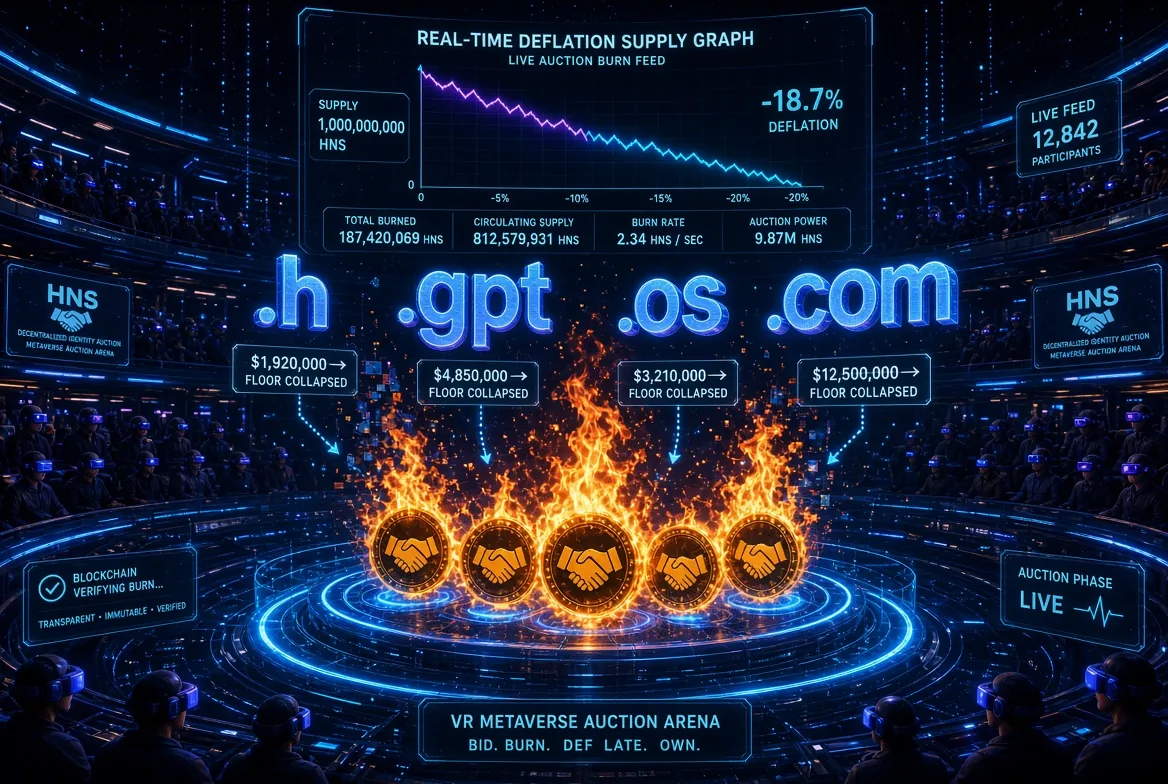
Bitcoin miners get paid. Ethereum validators get paid. On Handshake, something stranger happens every two weeks: HNS gets deleted. Not sent to a treasury, not locked in a vault, not held by a foundation — permanently removed from existence, with no key that could ever bring it back. That's token burning. Let's break down exactly what it is, how it works on Handshake, and why it matters for the long-term economics of the protocol.
Lesson 1: What "burning" actually means
Burning a token means sending it to an address (or a mechanism) with no known private key — a place nothing can ever spend from. Think of it like tearing up a dollar bill instead of putting it in a bank. The bill is gone. It doesn't exist anywhere anymore. Total circulating supply just went down by one dollar, permanently.
Most blockchains never do this. Handshake does it by design, every single day, as a core part of how the network assigns naming infrastructure.
Lesson 2: How burning happens on Handshake — the Vickrey auction
Every Handshake top-level domain (TLD) is claimed through a Vickrey auction — a sealed-bid auction where nobody can see anyone else's bid until the reveal period ends. The mechanics:
- Anyone can open an auction on an available TLD.
- Bidders lock up HNS for a set bidding window without revealing the amount.
- When the reveal period ends, the highest bidder wins — but pays only the second-highest bid, not their own bid.
- Losing bids are fully refunded.
- The winner's payment — the second-highest bid amount — is burned. Gone. Forever.
This is the opposite of a traditional auction house, which pockets the winning payment as revenue. On Handshake, nobody collects that HNS. Not the protocol, not miners, not a foundation. It simply leaves circulation. If you want the full walkthrough of how the auction itself works, see How Blockchain Gives You a Name Nobody Can Steal.
Lesson 3: Why design it this way instead of just charging a fee?
A Vickrey (second-price) auction encourages honest bidding — you have no incentive to lowball or overbid, because your own number never determines what you pay. That's good mechanism design on its own. But pairing it with a burn does something more: it removes the possibility of anyone extracting rent from the naming system.
Compare this to ICANN's model, where a central registry collects hundreds of thousands of dollars in TLD application fees and keeps them. On Handshake, the "fee" a winner pays isn't captured by anyone — it's destroyed. There's no party sitting at the top of the naming hierarchy quietly getting richer off everyone else's domain purchases. That absence of an extractive middleman is central to the sovereignty thesis behind Handshake as infrastructure.
Lesson 4: The economic result — real deflationary pressure
Handshake has a hard cap of 2.04 billion HNS, with new coins minted every 10 minutes through proof-of-work mining. Burning works against that inflation from the other direction. As of mid-2024, roughly 62.5 million HNS had already been burned through auctions since mainnet launch — and that number only grows as more TLDs get claimed and as existing names get re-auctioned or contested.
The effect on the economy is straightforward, even if the magnitude varies auction to auction:
- Supply shrinks with every auction. Unlike a typical crypto "burn event" that happens once as a marketing move, this is a continuous, structural feature of the protocol — baked into how names are assigned, not bolted on afterward.
- Demand for TLDs directly reduces circulating HNS. The more valuable and contested a name is, the more HNS gets destroyed to win it. High-profile auctions have burned enormous sums — some single-name auctions have burned hundreds of thousands of HNS in one event.
- Scarcity compounds over time. Every burned coin is gone permanently, so the deflationary effect doesn't reset — it stacks, auction after auction, indefinitely.
- No one profits from the burn itself. This matters economically as much as symbolically: there's no incentive for a central party to manipulate auction dynamics to enrich itself, because the payment isn't collected by anybody.
None of this guarantees price appreciation — token burning is a supply-side mechanic, not a demand guarantee. But it does mean HNS has a genuine, verifiable, non-inflationary sink built directly into its core use case: acquiring infrastructure-grade namespace. That's a very different economic model from tokens whose only "utility" is speculation.
Lesson 5: Why this matters for HNS as infrastructure, not just as a token
The burn mechanism reinforces the thing that actually matters about Handshake: it's not selling a currency, it's allocating scarce namespace through a mechanism that can't be gamed by a central authority. The economics and the infrastructure design are the same thing. You can't separate "what happens to the token" from "how sovereignty over a TLD gets assigned" — the burn is the proof that no one sits in the middle collecting rent on the internet's naming layer.
Lesson 6: The biggest burns in Handshake history
Some auctions have destroyed staggering amounts of HNS in a single event. A few of the largest on record:
- .h — roughly 4 million HNS burned, about 0.65% of the entire circulating supply at the time, gone in one auction.
- .gpt — 512,000 HNS burned as demand for AI-adjacent names spiked.
- .os — 250,000 HNS burned in a single-name auction.
These aren't isolated events. By early 2024, cumulative burns had already crossed roughly 8% of circulating supply — and that share has kept climbing every two weeks since, one auction at a time.
Lesson 7: "Burn Baby Burn" — the proposal to go further
Auction burns aren't the only burn mechanism the Handshake community has debated. A Handshake Improvement Proposal (HIP) nicknamed "Burn Baby Burn" argued for permanently destroying the unclaimed portion of the original open-source developer airdrop — hundreds of millions of HNS that were reserved for developers but never claimed years after launch.
The logic: unclaimed, zero-cost-basis supply hanging over the market creates uncertainty for miners and holders alike. Burning it removes that overhang entirely, so all future HNS issuance comes only from proof-of-work mining — no free coins waiting in the wings. It's the same underlying philosophy as auction burning, just applied to a different pool of supply: if HNS isn't earned through real work or a real bid, it shouldn't exist.
Lesson 8: How this compares to burn mechanisms on other chains
Token burning isn't unique to Handshake, but the reason for the burn is what sets it apart:
- Ethereum (EIP-1559): burns a portion of every transaction's base fee. This ties burning to network usage in general — the more people transact, the more ETH gets burned, regardless of what the transaction was for.
- BNB Chain: runs scheduled, discretionary burns funded by exchange buybacks — a centralized entity decides how much to burn and when.
- Handshake: burns are tied to one specific, meaningful economic action — winning the right to control a piece of internet namespace. There's no central party deciding the burn schedule or amount; it's purely a function of how competitive each auction is.
In other words, HNS burning isn't a monetary policy lever someone pulls — it's an emergent property of real demand for real infrastructure.
Lesson 9: The honest counterargument
It's worth teaching the pushback too, not just the upside. Some voices in the Handshake community have argued that burning alone doesn't solve the protocol's biggest challenge: sustainable funding for development. Destroying HNS reduces supply, but it doesn't put resources into the hands of the people building resolvers, wallets, and tooling. A healthy namespace economy needs both — scarcity and a way to fund the infrastructure that makes that scarcity useful. Burning is a strong signal of sound money design, but it's not a substitute for ecosystem investment on its own.
NIHON — Handshake Infrastructure & Web3 Identity.