

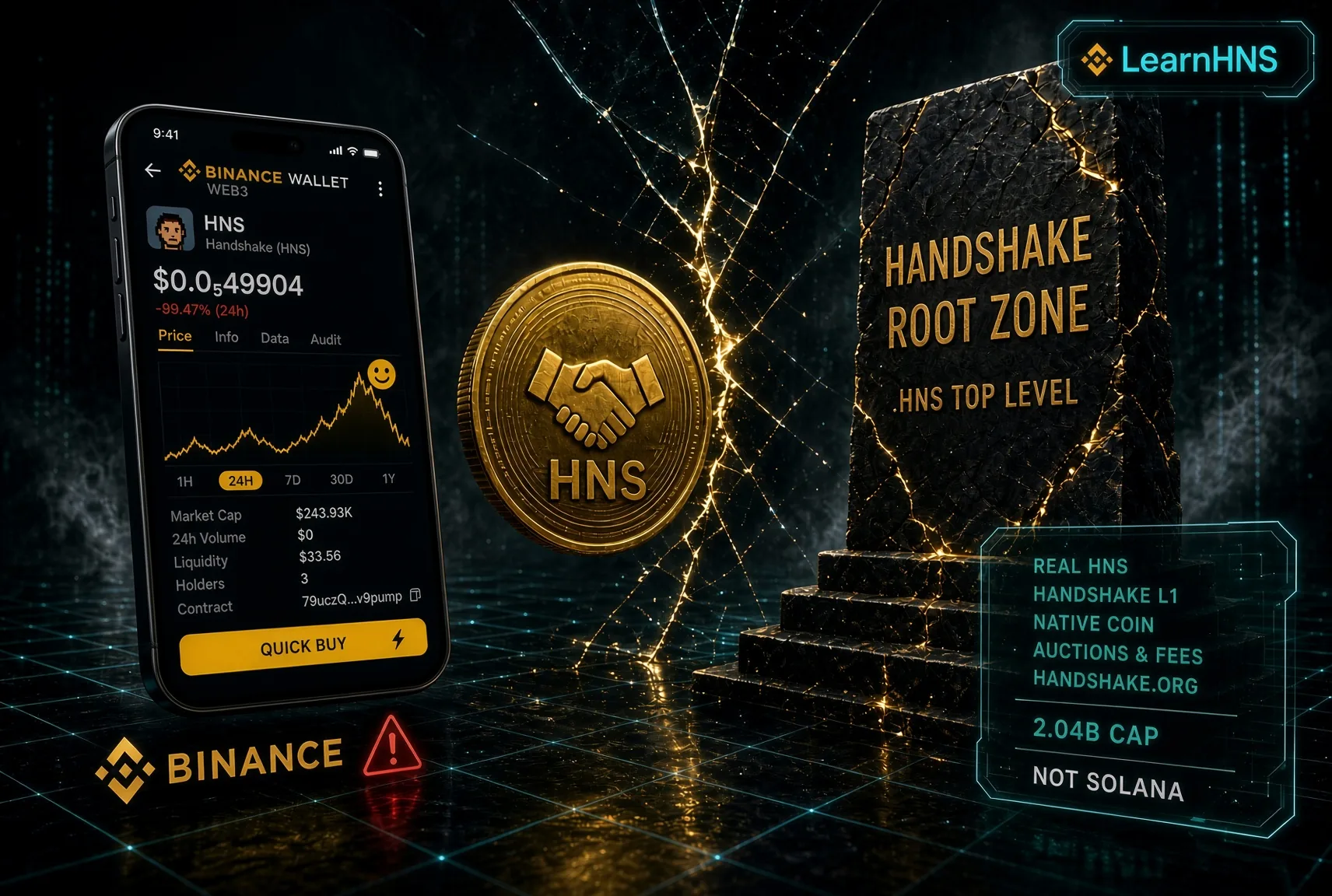
If you open the Web3 side of Binance Wallet and search for "HNS", you may find a token page with the ticker HNS, a price chart, and a big yellow Quick Buy button. It looks official. It is not. This token has no connection to Handshake, to the real HNS coin, or to any wrapped version of it. In this guide we explain what kind of token it is, how to read the numbers on a page like this, and how to avoid getting caught by look-alike tickers.
Real HNS vs a Look-Alike Token: The Data
The quickest way to see the difference is to compare the facts side by side.
| Property | Real HNS (Handshake) | Look-alike "HNS" launchpad token |
|---|---|---|
| Where it lives | Its own blockchain, Handshake | A contract on another chain such as Solana |
| What it is | Native coin of the network | A token created from a launchpad template |
| Supply | Capped at 2.04 billion HNS | Whatever the creator chose; often 1 billion on pump.fun |
| How it started | Mainnet launch in February 2020, with a large share airdropped to open-source developers | Minted in minutes by anyone, at almost no cost |
| Purpose | Bidding in name auctions and paying transaction fees | None beyond speculation |
| Block time | Targets about 10 minutes per block | Depends on the host chain |
| Identified by | The Handshake chain and its official documentation | A contract address, which is the only thing that makes it unique |
| Official links to Handshake | Yes | None |
For context on how HNS is actually used: in a Handshake name auction, bidding stays open for 5 days, followed by a 10-day reveal period. That is where HNS does its real work.
How to Read a Token Page
Every wallet and DEX screen shows roughly the same fields. Here is what each one means and what a worrying value looks like.
- Price with a subscript: a price such as $0.0549904 means five zeros after the decimal point, then 49904. That is about $0.000005. Tiny prices are normal for tokens with huge supplies and say nothing about value.
- Market cap: price multiplied by supply. On a token with 1 billion units, even a price of half a thousandth of a cent gives a few thousand dollars, and a small number of buyers can move it massively.
- Liquidity: the money in the trading pool that lets people swap. Under a few thousand dollars is thin; under one dollar means you effectively cannot sell.
- 24h volume: how much actually traded. Zero means nobody is buying or selling.
- Holders and top-10 share: few holders, or a top 10 that owns nearly everything, means a handful of wallets control the price.
- Contract address: on Solana, addresses ending in
pumpcome from pump.fun, a launchpad where anyone can mint a token. The suffix tells you where it was created, not that it is safe. - Token age and chart shape: one spike followed by long silence is typical of abandoned launches.
Why Does It Appear Inside Binance Wallet?
Binance Wallet's Web3 section is a window onto on-chain markets. It can display tokens that exist on supported blockchains, including ones that anybody created yesterday. Seeing a token there, even with the Binance name on the chart, is not the same as a listing on the Binance exchange, and it is not an endorsement or a security review. Tabs such as "Audit" and "Info" being present is not proof of legitimacy either.
Tickers Are Not Unique
This is the core lesson. A ticker like HNS is only a label. On a public blockchain nobody owns a ticker, so a hundred different tokens can all call themselves HNS, BTC, or ETH. What identifies a token is its contract address on a specific chain. Two tokens with the same name and the same logo can be completely unrelated.
What Real HNS Is
Handshake is its own blockchain, and HNS is its native coin. It is used to bid in name auctions and to pay transaction fees on the Handshake network, where people own top-level domain names and the names beneath them. It does not need a Solana or Ethereum contract to exist, and a token minted on pump.fun cannot be redeemed for it. If a token claims to represent HNS, the burden is on its creator to show a verifiable bridge or custody arrangement. A random launchpad token has neither.
A Quick Checklist Before You Buy Any Token
- Find the official source. For Handshake, start at the project's official channels and documentation, not a search box inside a wallet.
- Compare contract addresses. If a project has an official token on another chain, its address will be published by the project. If you cannot find one, assume it does not exist.
- Check liquidity and volume. Near-zero liquidity means you may not be able to sell.
- Count the holders. A handful of holders means a handful of people control the price.
- Look at the token's age and history. One spike followed by nothing is a warning sign.
- Be suspicious of urgency. Big buttons like "Quick Buy" are designed to make acting feel easy. Slow down.
- Never treat a wallet's search result as verification. Verify outside the app.
Is It a Scam?
We cannot say what a token's creator intended, and we are not claiming this specific token was made to deceive. Many launchpad tokens are simply throwaway experiments. What matters for you is the outcome: the name borrows the recognition of a real project, so someone searching for Handshake could easily confuse the two and lose money.
Key Takeaways
- The "HNS" token on Binance Wallet is a pump.fun style memecoin, unrelated to Handshake.
- Real HNS lives on the Handshake blockchain, with a 2.04 billion supply cap.
- A ticker proves nothing; the contract address and the project's official sources do.
- Appearing in a wallet app is not verification.
This article is educational and not financial advice. Always do your own research.
NIHON — Handshake Infrastructure & Web3 Identity.