

Lesson 1: What Just Happened
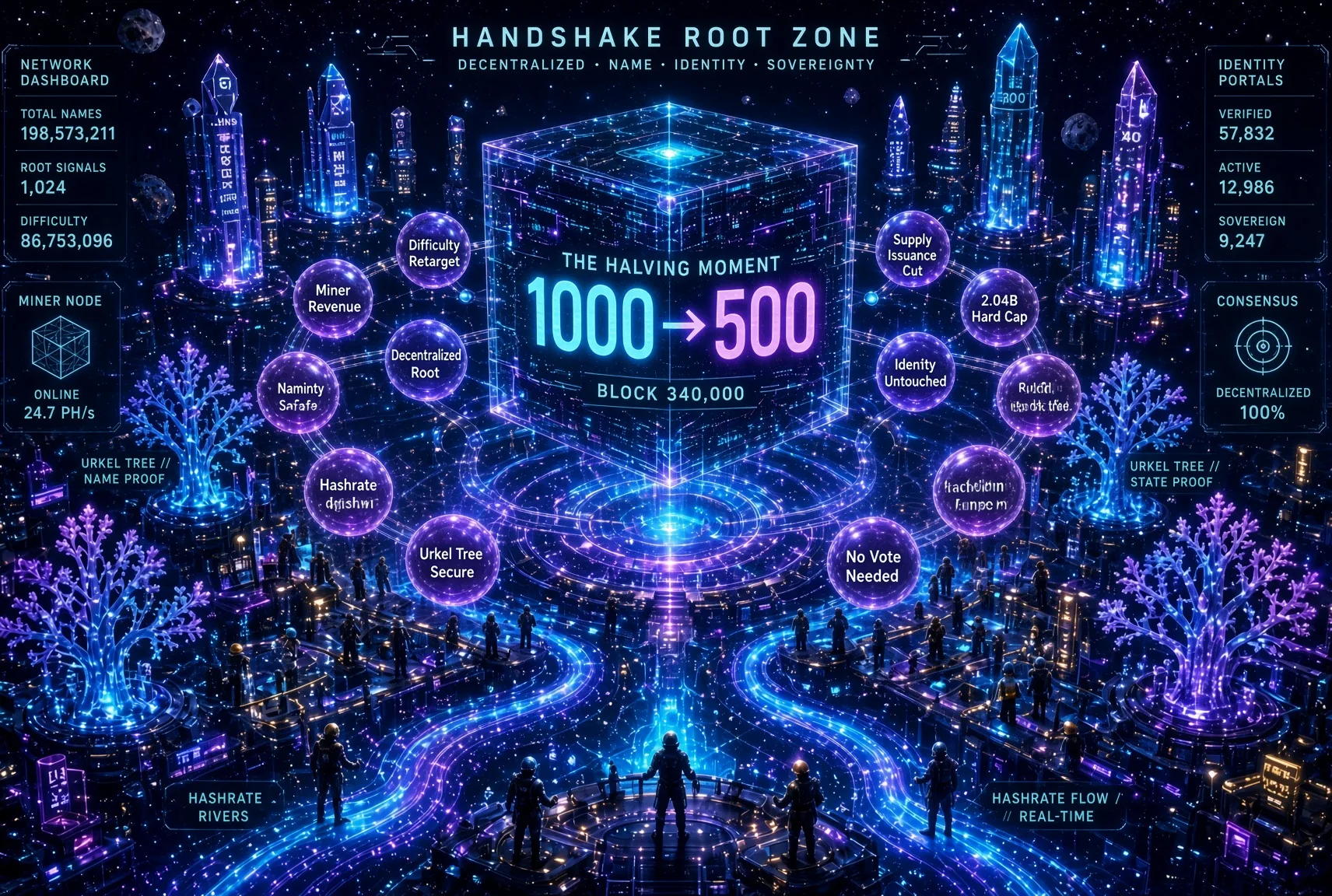
Handshake completed its second block reward halving in late July 2026, at block height 340,000. This is a hard-coded, unstoppable event written directly into the protocol's consensus rules — no vote, no foundation announcement, no committee decision. The chain simply crossed a block height and the issuance schedule changed itself.
Before the halving: every block mined paid out 1,000 HNS to whichever miner found it.
After the halving: that same block now pays out 500 HNS.
This is the second time this has happened. The first halving occurred back in April 2023, when the reward dropped from the genesis rate of 2,000 HNS down to 1,000 HNS. Handshake halves its issuance roughly every 170,000 blocks — at Handshake's ~10-minute block time, that works out to a cadence of a little over three years between halvings.
Lesson 2: Why This Isn't a Marketing Event
Unlike a lot of crypto "milestones," a halving isn't something a team ships. It's arithmetic. The Handshake protocol was designed from genesis with a hard-capped supply of 2.04 billion HNS, and the only way to reach that cap on schedule is to keep cutting new issuance in half at fixed intervals — the same mechanism Bitcoin uses, adapted for a naming-and-identity chain rather than a payments chain.
That distinction matters. On Handshake, the block reward doesn't just pay for moving coins around — it pays for securing a decentralized alternative to the ICANN root zone. Every halving is really a stress test of one question: does the network still have enough incentive to keep mining honestly once the subsidy drops?
Lesson 3: What Changed Under the Hood
Three things move immediately at a halving:
1. Miner revenue per block was cut in half overnight. Any miner running the numbers on electricity cost versus HNS payout had their margin compressed instantly, with no ramp-up period.
2. New supply issuance rate dropped. Handshake was already disinflationary before this halving; afterward the rate at which new HNS enters circulation slows further, pushing the network closer to its long-run fixed-supply end state.
3. Difficulty adjusts to whatever hashrate remains. If some miners walk away because the reward no longer covers their costs, Handshake's retargeting brings block times back toward the ~10-minute target using whatever hashrate is left securing the chain. The chain doesn't need constant hashrate — it needs hashrate that adjusts, which is exactly what proof-of-work is built to do.
Lesson 4: The Miner Shakeout
Every halving in every proof-of-work network produces the same pattern: the least efficient miners — old hardware, high electricity costs, thin margins — become unprofitable first and drop off. What's left is a smaller but leaner set of miners who can operate at the new reward level. This isn't a flaw in the design; it's the design working as intended. A halving is Handshake's way of periodically asking its miners, "are you still committed at this price?" and letting the market answer.
This is also exactly why LearnHNS has been tracking mining pool accountability — when the subsidy drops, pool concentration and honest reporting matter more, not less, because there's less margin for error or manipulation to hide in.
Lesson 5: What Doesn't Change
A halving does not touch the parts of Handshake that actually make it useful as naming infrastructure for identity:
- TLD ownership and the Urkel-tree-backed name auction system are untouched.
- DANE/TLSA-based certificate anchoring keeps working exactly as before.
- Existing name renewals, transfers, and resolution are unaffected — a halving is a monetary policy event, not a naming-layer event.
In other words: the halving changes how many new HNS enter existence per block. It says nothing about whether the identity and infrastructure already secured by the chain are any less real.
Lesson 6: Reading the Market Reaction Honestly
HNS price action around this halving has been volatile in both directions over the surrounding weeks — which is normal. Halvings are widely anticipated events, and in efficient markets a lot of the "supply shock" narrative gets priced in ahead of time rather than after. LearnHNS doesn't do price predictions, and neither should you base a thesis purely on "supply went down, therefore price goes up." Scarcity is necessary but not sufficient — demand for the naming and identity layer Handshake actually provides is what has to grow for the economics to matter long-term.
The Takeaway
The second halving is confirmation that Handshake's monetary policy runs exactly as written, with zero discretion, three years after the first one did the same thing. That predictability — not the price chart in the days after — is the actual story. A protocol whose issuance schedule you can verify years in advance, on a public ledger, without trusting anyone to keep a promise, is precisely the kind of infrastructure decentralized identity needs underneath it.
NIHON — Handshake Infrastructure & Web3 Identity