

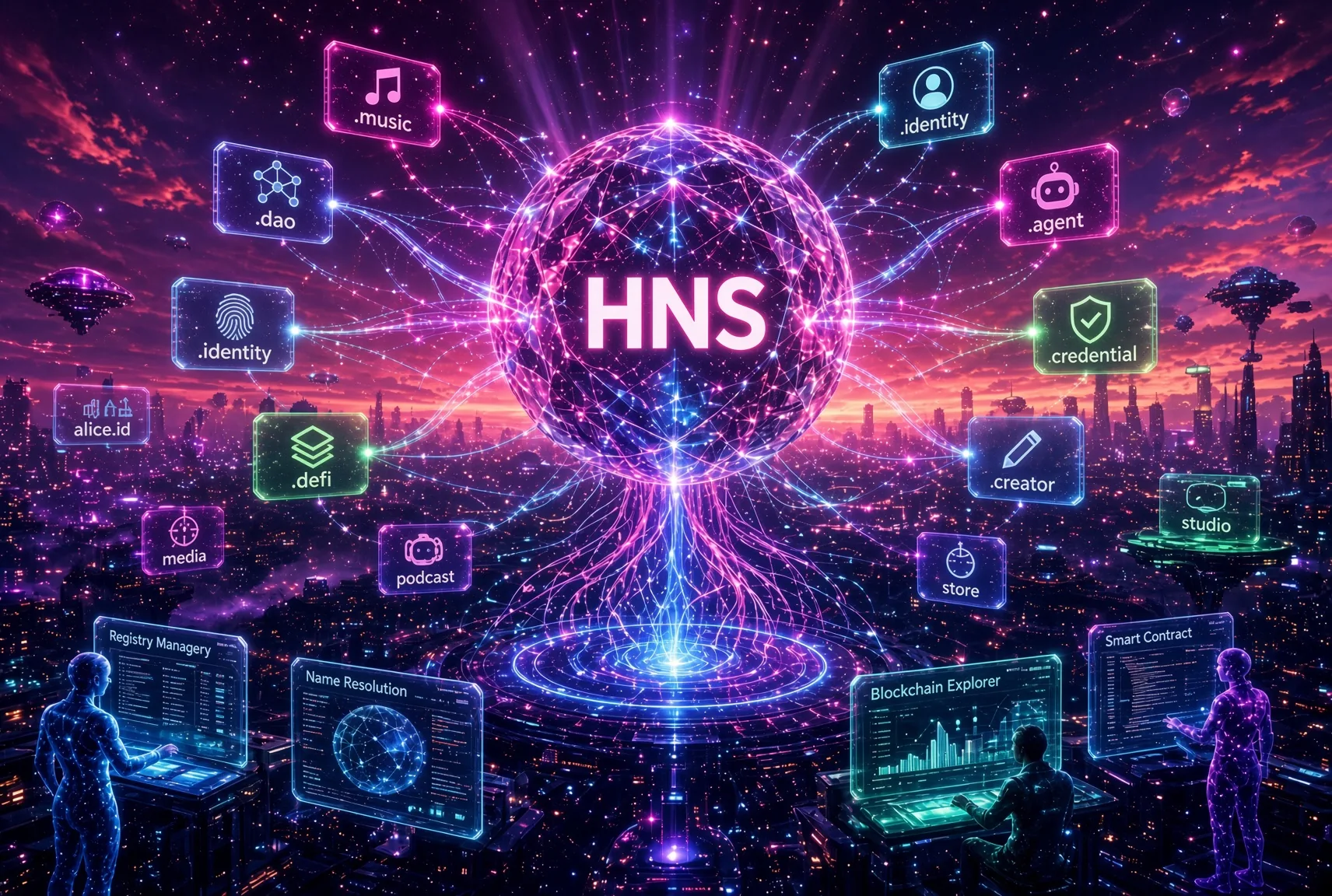
Most people look at Handshake and see "alternative domains." That's the shallow read. What HNS actually hands you is a piece of internet root infrastructure you can own outright, with no registry gatekeeper and no renewal-at-their-mercy pricing model. That's not a naming product. That's a raw material.
Below is a working list of startup ideas that treat Handshake TLDs and SLDs as building blocks rather than collectibles. Some are TLD-level plays (you own the root, you set the rules for everyone underneath). Some are SLD-level plays (you build a product or brand on a single name you registered). A few combine both.
TLD-Level Startups (you own the root)
1. Vertical-specific namespace registries. Own a TLD like a niche industry term and run it as a mini-registry: sell SLDs under it to businesses in that vertical, with your own pricing, resolution rules, and verification layer. Think a TLD for independent musicians, one for local restaurants, one for open-source projects. You're not selling a domain — you're selling membership in a namespace with built-in discoverability.
2. DNS resolution-as-a-service for a TLD. Owning the TLD doesn't mean much if resolution is painful. Build the resolver, the DANE/TLSA tooling, and the onboarding flow for people who register SLDs under your root, and charge for managed resolution, wallet integration, or email-over-HNS setup. This is infrastructure arbitrage: you monetize the friction between "I own a name" and "my name actually works everywhere."
3. TLD-as-a-franchise model. License sub-brands under your TLD the way franchise systems work in the physical world. A regional TLD, for instance, could let verified local businesses register SLDs with automatic geographic and identity verification baked into the covenant logic.
4. Credential and certification TLDs. A TLD scoped to professional credentials — trades, medical licensure, security certifications — where an SLD registration under the root requires proof of the credential. The TLD itself becomes the trust anchor. This is closer to a verifiable-credentials product than a domain product, but Handshake's covenant system is what makes it enforceable without a central certifying authority.
SLD-Level Startups (you build on one name)
5. Domain-bound NFT products. Bind a limited series of NFTs to a single SLD's namespace — tickets, memberships, or collectibles that only resolve or verify under your domain. This is the same design space as DNMT-style domain-bound tokens: the domain isn't the product, it's the verification layer the product depends on.
6. Real estate and asset registries on a single SLD. Use one SLD as the root of a property or asset registry, with subdomains representing individual listings, deeds, or shares. A real estate NFT protocol on HNS infrastructure is a working example of this pattern: the SLD becomes the canonical, censorship-resistant address book for an asset class.
7. Decentralized identity and reputation SLDs. A single SLD that functions as an identity anchor — subdomains as verified sub-identities, DANE-backed key rotation, and a reputation layer built on top. Sell it as "own your identity infrastructure" to creators, freelancers, or DAOs who don't want to depend on a platform-issued handle.
8. Private, encrypted communication under your own name. Use an SLD to anchor email, messaging, or file-sharing that resolves without relying on centralized DNS or platform accounts. The pitch is simple: your comms infrastructure lives at a name only you control, not a name a registrar can seize.
9. Content publishing and paywall infrastructure. A publishing platform where each creator gets a subdomain under your SLD, with payment rails, DANE-secured content integrity, and no platform de-listing risk. This is the direct commercial extension of what educational and publishing projects on HNS are already doing manually.
10. AI agent identity SLDs. As autonomous agents start needing verifiable, persistent identities on the internet, an SLD can function as an agent's home namespace — subdomains per agent instance, covenant-enforced ownership transfer, and a resolution layer that proves which agent is which. This ties directly into the broader question of what identity infrastructure AI agents will need as they operate independently online.
Combined Plays (TLD root + SLD product)
11. Multilingual and Unicode-native identity platforms. Own a TLD, then build a product on top that specifically serves non-Latin-script users — Punycode-aware registration, localized resolution tooling, and a business model around underserved language markets that traditional gTLDs handle poorly.
12. Quantum-resistant migration services. As the "when do we need post-quantum signatures" conversation matures, a startup that helps TLD and SLD owners migrate their key material and covenant setups to quantum-resistant schemes — before it's an emergency — is a service business hiding inside a protocol upgrade cycle.
13. Mining pool and network accountability tooling. Not domain-facing at all, but still root-infrastructure-adjacent: dashboards, alerting, and scoring systems that track centralization risk across HNS mining pools, sold as a trust layer to exchanges, wallets, and serious holders.
The common thread
Every idea on this list treats the TLD or SLD as infrastructure with a covenant attached, not as a static asset to flip. The businesses that will actually work are the ones that make ownership of a name do something — verify a credential, anchor an identity, gate a resolver, or enforce a transfer rule — rather than the ones that just resell scarcity.
If you're resolving any of the names above, use a browser that actually supports HNS root resolution natively — SkyInclude Browser or DANE HNS Browser are the current reliable options.
NIHON — Handshake Infrastructure & Web3 Identity.