

Right now, your devices don't really have names
Think about how many things in your house connect to the internet: your phone, your laptop, your smart TV, maybe a thermostat, a doorbell camera, a light bulb. Each one gets online, but almost none of them has a real name the way your website does. Instead they get assigned things like 192.168.1.47 or a random string generated by whoever manufactured them.
That's fine when it's just your own home network. It stops being fine the moment devices need to talk to each other across the open internet, prove who they are, and be trusted by other devices they've never met before. And by 2030, there are expected to be more than 75 billion of these devices online. That's roughly ten devices for every single person on Earth.
Why "just give every device a name" is harder than it sounds
The naming system the internet already has is DNS, the same system that turns "google.com" into an address a computer can use. It was built for a world where a company registers one domain, points it at one server, and that's the end of the story.
Now imagine trying to run that same system for billions of individual sensors, cameras, and appliances, each one needing its own verifiable name, each one getting swapped out or decommissioned constantly, and each one needing to prove to other devices "yes, I really am the thermostat you think I am" without a human being involved to check. Centralized DNS was never designed for that kind of scale, and it wasn't designed for machines authenticating other machines at all.
This is why, in 2026, machine identity has quietly become one of the biggest problems in cybersecurity. Security teams now manage more machine identities than human ones, and most of them still rely on centrally-issued certificates that have to be tracked, rotated, and revoked by hand at a scale no team can really keep up with.
What a Handshake name actually gives a device
Handshake lets anyone own a name directly on a decentralized root, without asking a company or registrar for permission. That single idea solves two problems at once for devices:
- A device can own its own name. Instead of a manufacturer or cloud platform controlling the identity of every device it ships, the device (or its owner) holds the name directly, the same way you'd hold the deed to a house.
- Other devices can verify that name without asking a central authority. Because the root itself isn't controlled by one company, a device can check "is this name real and who owns it" by looking at the Handshake blockchain, not by calling home to whichever corporation issued the credential.
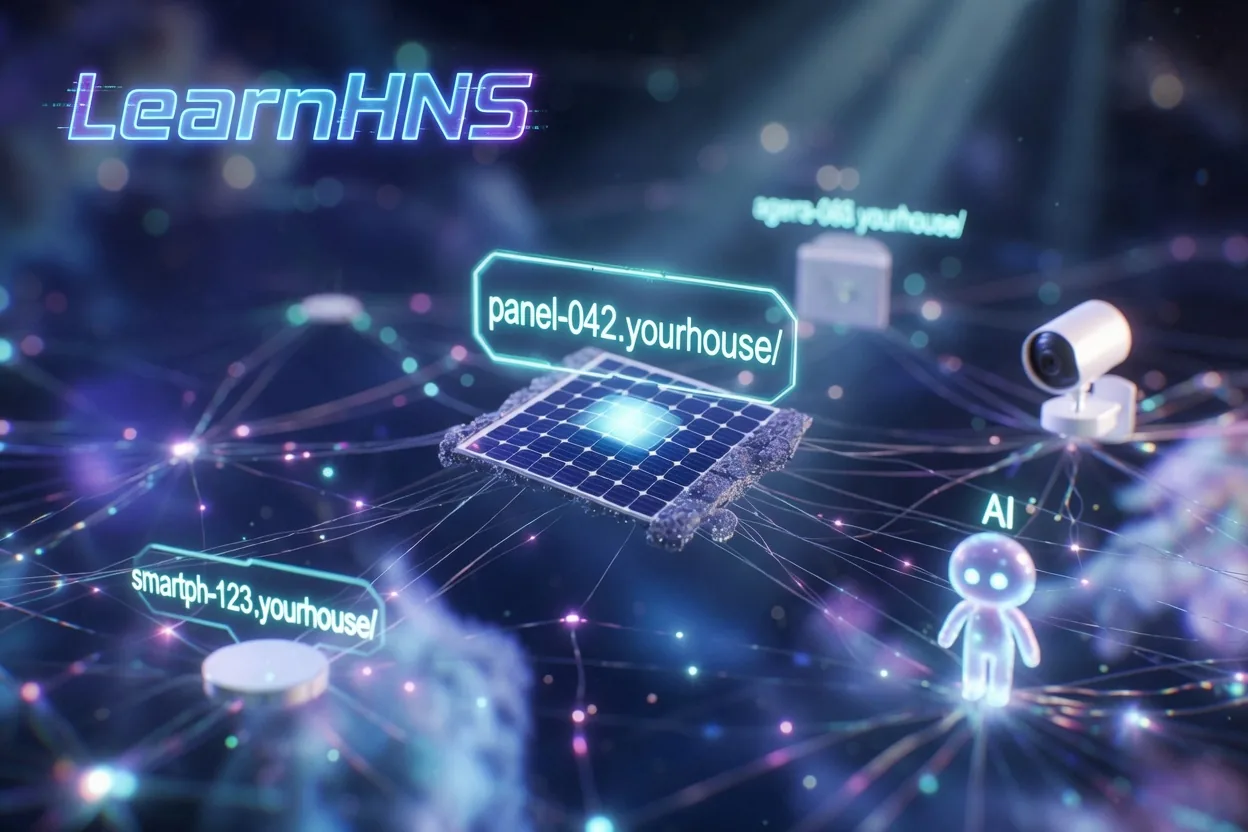
Picture a solar panel on your roof with its own Handshake name, like panel-042.yourhouse/. It can report data, receive firmware updates, and negotiate with your home energy system, and any of those systems can confirm it's really your panel just by checking the name against the Handshake chain. No manufacturer's server has to stay online forever for that trust to keep working.
This is the same underlying problem that AI agents face when they act on your behalf. A device and an autonomous agent both need a name they can hold themselves and prove without a middleman, and both can lean on ZK proofs to authenticate without leaking unnecessary data every time they do.
This isn't a workaround. It's the better default.
It's easy to frame Handshake as "the alternative to DNS when DNS breaks." That undersells it. For machine identity specifically, Handshake isn't a fallback option, it's simply a better fit for the job than the system we're currently forcing to do it. A billion-device world needs a naming system that doesn't depend on one company's servers staying online, one registrar staying honest, or one central authority approving every new name one at a time.
People choosing Handshake for their own domains today are already using the same infrastructure that device identity at scale will eventually need. It's the same root, the same ownership model, just applied to a thermostat instead of a blog.
Written by NIHON — Handshake Infrastructure & Web3 Identity.