

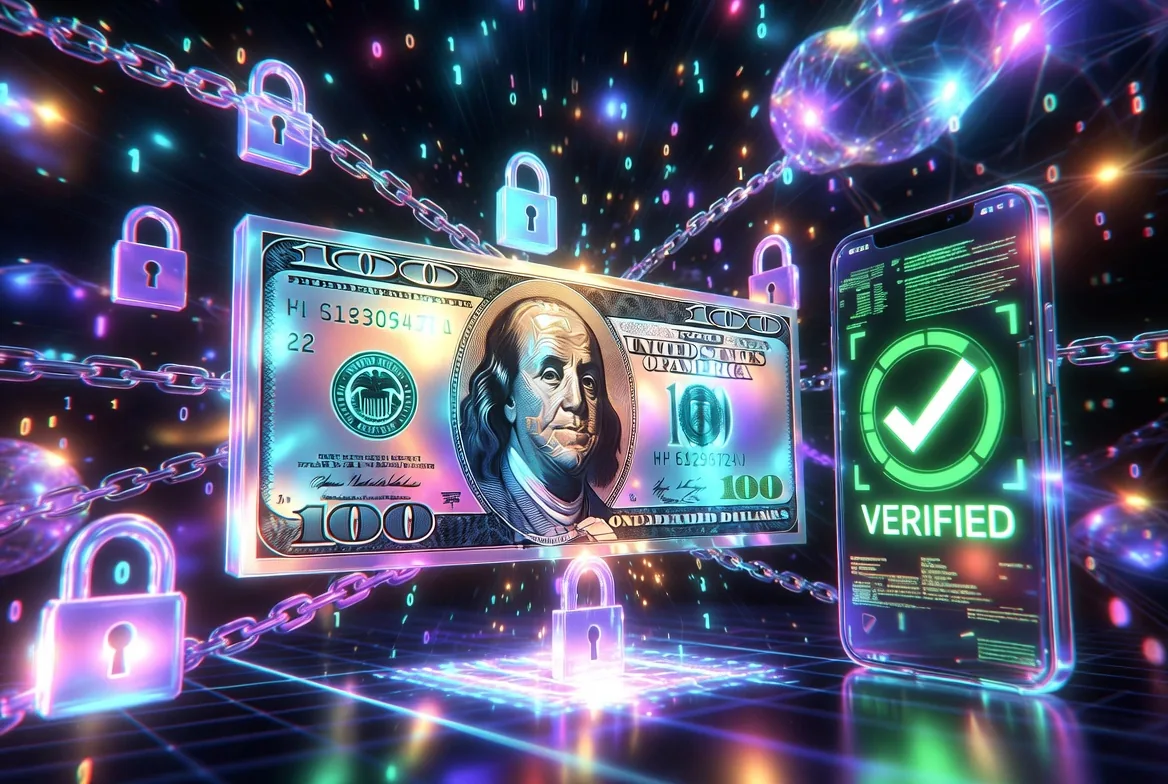
Right now, a $50 bill and a $50 bill are interchangeable, that's the whole point of cash. But what if they weren't? What if every single note had its own permanent, verifiable identity, the way a passport or a car has a VIN number? This is a teaching post on whether that's technically possible, how Handshake fits into the picture, and who actually benefits if it happens.
Yes, and it's already half-built
Every banknote already carries a unique serial number, so the "each note is different" part isn't new. What's missing is a trustworthy, tamper-proof link between that printed number and a verifiable digital record. Patents going back over a decade describe exactly this: a currency note carrying a watermark serial number, a printed serial number, and a digital signature that cryptographically binds the two together using a private key held by the issuing authority. Anyone with the matching public key can check that the signature is genuine, without needing to trust a central lookup service in real time.
Add a physical anchor, an NFC chip embedded in the paper, a microprinted QR code, or a security thread readable by a phone, and you have the same pattern already used in supply-chain anti-counterfeiting for luxury goods and pharmaceuticals: a unique digital identifier tied to a physical object, recorded on a tamper-evident ledger, checkable by anyone who scans it.
Why blockchain instead of a central database
A central bank could build a private database mapping serial numbers to status flags without touching blockchain at all. The reasons to use a public, cryptographically anchored ledger instead are the same reasons Handshake TLDs exist for banking infrastructure in general:
- No single point of failure. A centralized "is this note real" server is a target. If it goes down, gets hacked, or gets DNS-hijacked, verification stops working everywhere at once.
- Independent verification. A bank, a merchant, and a citizen's phone app should all be able to check a note's status without asking permission from a middleman each time.
- Tamper evidence over time. A ledger-based record shows the full history of a note's status changes, issued, recalled, reported stolen, retired, and that history can't be quietly edited after the fact.
Where Handshake fits
Handshake doesn't replace the cryptography that binds a serial number to a signature, that's a job for the central bank's own key infrastructure. What Handshake solves is the layer above it: how do verifiers actually find and trust the right lookup endpoint, anywhere in the world, without relying on a corporate-controlled domain that can be seized, censored, or DNS-hijacked?
- A national mint could hold its own Handshake TLD, the same way a bank might use one for banking security, instead of a rented ICANN domain that renews under someone else's terms.
- DANE/TLSA-style certificate pinning (already covered on this site for banking infrastructure) means a verification endpoint's certificate is anchored directly in the DNS record, cutting out the certificate-authority weak link that phishing sites exploit.
- Ownership of the TLD lives on-chain, controlled by a private key, so it can't quietly be reassigned to a different registrant the way a traditional domain can under a court order or registrar mistake.
- Resolution happens through a decentralized resolver like SkyInclude Browser, so the "is this note genuine" check doesn't depend on a single company's infrastructure staying online.
In short: the note's identity record can live in whatever database the central bank chooses, but the address people use to reach that record can be censorship-resistant and independently verifiable, instead of one more corporate domain that can be taken down.
What this actually gives a government
- Counterfeiting becomes economically pointless. A fake note can copy the printed serial number, but it can't forge a valid signature without the private key, and it can't fake a ledger entry that was never created.
- Faster, cheaper recalls. If a batch of notes is compromised, the identity registry can flag exactly which serial numbers to pull, instead of blanket currency swaps.
- Better anti-money-laundering data. Large cash movements already get flagged manually; a scannable identity layer makes suspicious clustering (the same notes reappearing in unrelated transactions) far easier to detect.
- Lower long-run production cost. Advanced anti-counterfeiting today relies on holograms, microprinting, and special substrates. A cryptographic identity layer is a one-time infrastructure cost that scales to unlimited notes.
What this actually gives a citizen
- Instant authenticity checks. A merchant or a person receiving cash could scan a note and get a cryptographic yes/no on whether it's genuine, on the spot, without depending on trained eyesight or a UV lamp.
- Loss and theft protection that cash has never had. Today, if cash is stolen, it's simply gone. A registry that can flag specific serial numbers as reported-stolen (without freezing the underlying value) starts to close that gap, something cards and bank transfers have long had and cash never could.
- Trust without a bank account. Anyone can independently verify a note using a public key, with no login, no KYC step, and no dependency on being banked in the first place.
The honest tradeoff: privacy
This is the part worth being direct about. Cash's core social value has always been that it's untraceable, a $20 bill doesn't remember who held it last. A serialized identity layer that logs scans over time starts to erode exactly that property, and turns physical cash into something that behaves more like a tracked digital payment.
There's a real design choice buried in here, not a technical footnote:
- A system that only checks "is this note genuine" without logging who scanned it preserves most of cash's anonymity while still killing counterfeiting.
- A system that logs every scan with location and identity data effectively turns paper money into a surveillance instrument, which is a legitimate concern raised by privacy advocates and civil liberties groups whenever governments discuss traceable cash.
Which version gets built is a policy decision, not a cryptography decision. The underlying tech, signatures, tamper-evident tags, decentralized name resolution, supports either outcome equally well.
The teaching takeaway
Giving every banknote a digital identity isn't speculative, the cryptographic pieces (unique serials, digital signatures, physical tags) have existed in patents and pilot programs for years. What's been missing is a censorship-resistant way to publish and verify that identity data without routing every check through one company's servers. That's the specific gap Handshake-style infrastructure is built to close, not by storing the money itself on-chain, but by making sure the address you trust to verify it can't be seized or silently redirected.
Architecture and original research by NIHON, Handshake Infrastructure & Web3 Identity.