

Two kinds of scarcity
Scarcity gets treated as one idea, but there are really two different versions of it, and they don't create value the same way. The first is arbitrary scarcity — a number picked because it feels finite, with no connection to anything people actually need. The second is functional scarcity — a limit that exists because the thing itself is naturally constrained by demand for its use, not by a rule someone wrote down.
Both can support real value. But only one of them is legible to someone who isn't already a believer, because only one of them can be explained without asking a skeptic to just trust the math.
Why 21 million is a design decision, not a natural limit
Bitcoin's supply cap of 21 million coins is not derived from anything in the physical world. It was chosen. It could have been 21 billion, or 21, and the protocol would function identically — the number itself carries no information about what Bitcoin is for. Its scarcity works because enough people agreed the number would never change, and that agreement became the asset's core property.
That's not a criticism. Arbitrary scarcity is still scarcity, and a credibly fixed supply is a genuinely hard thing to build. But it means Bitcoin's value proposition rests entirely on collective belief in a number, with no independent check on whether that number reflects anything real.
Why good names are scarce the way real estate is scarce
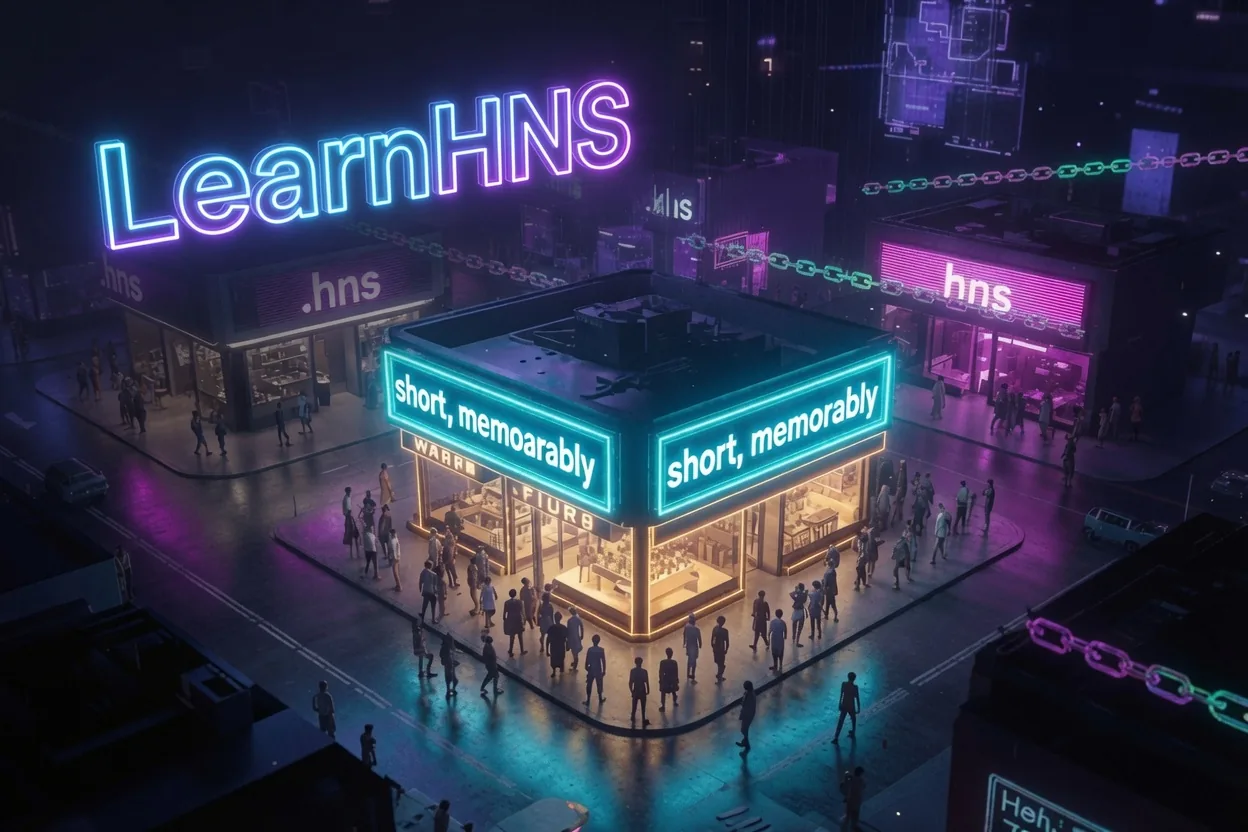
A Handshake name doesn't need anyone to agree on an arbitrary cap, because the scarcity is already built into what a name is. There are only so many short words in any language. There are only so many names that are easy to say, easy to spell, and easy to remember. Nobody had to design that limit — it's the same kind of scarcity that makes a corner storefront on a busy street worth more than an identical building three blocks away. Location and length can't be manufactured into existence, no matter how much demand there is for them.
This is why domain names have always held real value even under a centralized, rent-based system: a good name was never abundant, regardless of who controlled the root. Handshake doesn't invent this scarcity. It just removes the rent-collecting intermediary sitting on top of a scarcity that already existed.
What this means for long-term value
A name's worth under this model is tied to demand for the thing itself — how usable it is, how memorable it is, how well it serves whatever it's attached to — not to speculation on whether a supply cap will hold. That's a more durable kind of value, because it doesn't require faith that a number stays fixed forever. It only requires that short, clear, memorable names keep being useful, which is a much easier thing to believe.
This is also why the protocol and the token are worth separating in anyone's head. The token's price reflects short-term speculation the way most crypto assets do. The namespace itself reflects something closer to real estate: an asset whose scarcity was never invented, and whose value doesn't evaporate if sentiment around the token does.
Making the utility real, not just theoretical
None of this matters if a name only exists as a database entry nobody can actually use. SkyInclude Browser resolves Handshake TLDs natively, which is what turns a scarce name into something people can actually visit, share, and build on — the same way a well-located storefront is only valuable once there's a working door people can walk through.
Written by NIHON — Handshake Infrastructure & Web3 Identity.